
Energy Tea Timing: How to Use Green Tea Without Disrupting Sleep
HiherbsOfficial
The afternoon slump is a familiar negotiation: you want to stay sharp through the rest of the workday, but a caffeinated drink taken too late leaves you staring at the ceiling hours after you planned to be asleep. The question isn't whether green tea provides a real caffeine lift — it does. The question is where to place it in your day.
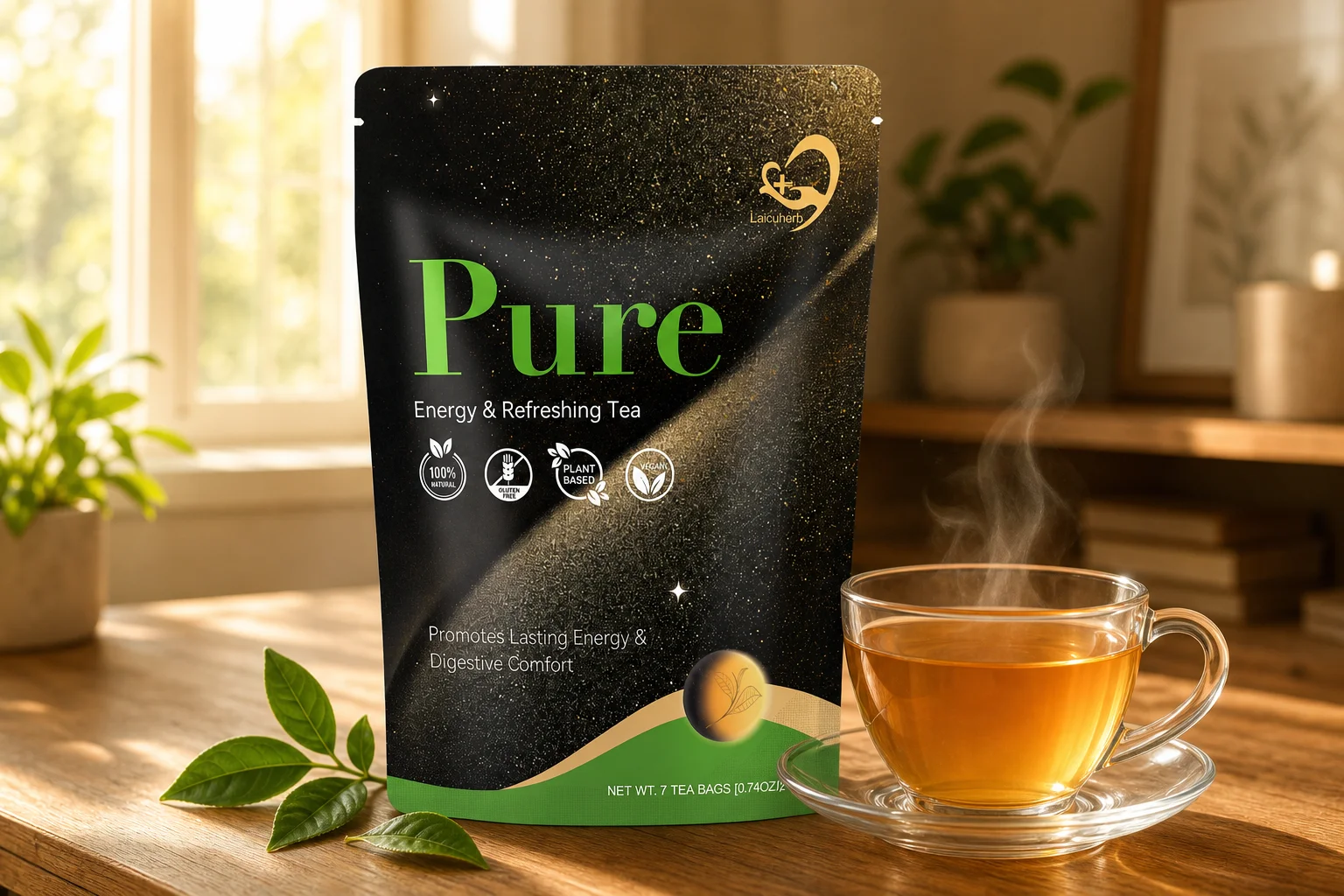
Laicuherb Pure Energy & Refreshing Tea is a green-tea blend with lotus leaf, cassia seed, moringa, and mulberry leaf, supplied in 3 g sachets (7 per pack). Because green tea is a genuine caffeine source, Pure Tea should be treated as a caffeinated beverage — not a caffeine-free herbal infusion. The product page does not specify a caffeine amount per sachet, which means this guide works with what the evidence can reasonably support rather than a number we don't have.
Contents
- → Quick Answer: Your Cutoff Is Personal
- → What's Actually in Pure Tea
- → Why Caffeine Half-Life Changes the Timing Math
- → Morning vs Afternoon: A Practical Framework
- → Food, Hydration, and Stomach Tolerance
- → How to Track Your Own Response
- → Who Should Limit Caffeine or Ask a Clinician
- → Conclusion
- → FAQ
Quick Answer: Your Cutoff Is Personal
A practical starting point:
Finish Pure Tea by early-to-mid afternoon, or at least six hours before your usual bedtime. If you notice lighter sleep, more nighttime waking, or difficulty falling asleep — move the cutoff earlier. If sleep stays unchanged, you have useful data about your personal caffeine tolerance.
No single cutoff hour applies to everyone. How quickly your body processes caffeine is shaped by genetics, age, liver enzyme activity, habitual intake, medications, and whether you are pregnant or breastfeeding. Two people who drink the same cup at the same time can have very different nights. The six-hour starting point comes from caffeine-sleep research, not from a guarantee about one sachet of Pure Tea [3].
The most honest framing is this: give caffeine enough distance from sleep that you can observe your own response clearly, then adjust the window based on what you find.
What's Actually in Pure Tea
The five declared ingredients in Laicuherb Pure Energy & Refreshing Tea are: green tea, lotus leaf, cassia seed, moringa, and mulberry leaf. Each sachet weighs 3 g; one pack contains seven sachets. The product carries COI, COA, HALAL, ISO-FSSC, HACCP, and SGS documentation — these support quality and traceability, not a specific metabolism claim.
The presence of green tea as the first listed ingredient means Pure Tea is a caffeinated product. It should not be described as herbal-only or caffeine-free. How much caffeine ends up in a brewed cup is influenced by the leaf grade, water temperature, steeping duration, and serving size — the product page doesn't specify a per-sachet caffeine figure, and this article doesn't supply one.
Brew Pure Tea as directed on the pack. It is a brewed beverage — not for external use, cooking, or medical treatment. Traditional associations with individual ingredients do not guarantee a digestive, energy, or sleep outcome for any specific person.
Why Caffeine Half-Life Changes the Timing Math
Caffeine half-life is the time it takes the body to clear roughly half of the caffeine present in the bloodstream. For healthy adults, this is generally measured in several hours — but the exact figure varies between individuals and changes with age, pregnancy, liver function, and certain medications. It is a useful concept, not a fixed personal number you can look up.
A controlled trial by Drake et al. (2013) tested 400 mg of caffeine at three points before sleep: at bedtime, three hours prior, and six hours prior. All three conditions reduced sleep compared with placebo — including the six-hour dose, which still reduced total sleep time by about one hour on average [3]. This study used a defined 400 mg dose rather than one sachet of Pure Tea. It doesn't tell us that every green-tea cup causes the same result, but it does demonstrate that the distance between a caffeinated drink and bedtime is not purely a comfort preference — it has measurable sleep consequences.
The implication for a tea drinker: a 4 p.m. cup may still be active at 10 or 11 p.m., especially for someone who metabolizes caffeine slowly. Half-life is a reason to think carefully about timing — not a permission slip for a universal cutoff rule.
Morning vs Afternoon: A Practical Framework
Morning window
Maximum clearance time before sleep. The simplest default for most people. Works well when you wake early and sleep before midnight. Low-risk starting window for new users.
Early afternoon window
May suit people with later bedtimes and lower caffeine sensitivity. Risk increases the closer the cup moves toward bedtime. Monitor sleep quality and adjust if needed.
If your bedtime is 10 p.m., finishing Pure Tea by mid-afternoon gives about six hours of clearance — a reasonable experiment. If your bedtime is midnight, the same clock time may land differently, but a six-hour buffer still applies as a starting rule. Shift workers, people with irregular schedules, and anyone managing anxiety, pregnancy, or prescription medicines may need a different calculation entirely.
The goal isn't a magic hour — it's creating enough separation to read your own sleep without guessing what caused the disruption.
Food, Hydration, and Stomach Tolerance
Caffeine on an empty stomach can trigger nausea, reflux, or jitteriness in some people. For others, it causes no trouble at all. If you find Pure Tea uncomfortable before eating, try pairing it with a meal or light snack rather than forcing the timing. You can also experiment with a shorter steep time, which may reduce the intensity of the cup.
Tea contributes to fluid intake, but shouldn't substitute for your broader hydration throughout the day. Ordinary moderate tea intake isn't a clinical dehydration risk for most adults, but water remains part of the daily picture regardless.
The additional botanicals in Pure Tea — lotus leaf, cassia seed, moringa, and mulberry leaf — are part of the blend's character. Traditional associations with these ingredients don't guarantee that the finished tea prevents stomach upset or improves digestion for every individual. Personal tolerance is the more reliable guide than ingredient reputation.
How to Track Your Own Response
Population averages don't tell you how caffeine moves through your particular system. A simple personal log does. For one to two weeks, note: the time you drank Pure Tea, the serving amount, whether you also had coffee or other caffeinated products that day, how long it took to fall asleep, how many times you woke during the night, and how rested you felt in the morning.
What to log each day
- Tea time and estimated amount
- Other caffeine sources (coffee, cola, chocolate)
- Sleep onset — roughly how long to fall asleep
- Number of night wakings
- Morning alertness rating (1–5, your own scale)
- Stomach comfort after drinking
Change one variable at a time when possible. If a later cup is followed by disrupted sleep across several days, move the cutoff earlier. If sleep stays consistent, that's meaningful data too. Keep the experiment boring and repetitive — dramatic conclusions usually require more than a few data points.
For questions about the product's ingredient list or certification documents — useful context to share with a pharmacist or clinician — contact hiherbs0129@gmail.com.
Who Should Limit Caffeine or Ask a Clinician
Seek clinical guidance if you
- Are pregnant or breastfeeding
- Have anxiety that worsens with stimulants
- Have diagnosed heart-rhythm concerns
- Have chronic insomnia or sleep disorders
- Take stimulant, thyroid, or other caffeine-relevant medications
- Have been advised to limit stimulants
Stop and seek advice if you notice
- Persistent palpitations or racing heartbeat
- Chest discomfort
- Severe or worsening anxiety
- Fainting or near-fainting
- Repeated significant sleep disruption
- New or unexplained symptoms after starting
Pregnancy and breastfeeding: Pure Tea contains green tea and is not caffeine-free. This article does not provide an individualized caffeine amount for pregnancy or lactation. Ask your doctor, midwife, or qualified clinician what caffeine level is appropriate for your situation — do not rely on a general blog cutoff.
Conclusion
Three things to take with you
- Green tea means real caffeine. Pure Tea is not a caffeine-free herbal blend and shouldn't be treated like one.
- Six hours is a starting point, not a guarantee. The research basis is real [3], but your personal cutoff depends on your metabolism, sleep schedule, and caffeine history.
- Quality documents describe manufacturing, not metabolism. COA, ISO-FSSC, HACCP, and HALAL certifications confirm how the tea is made — your own response to caffeine is a separate variable.
Morning is the lowest-risk window to start. Early afternoon can work for some people, depending on bedtime and sensitivity. Track the actual effect on your sleep over a week or two, adjust the cutoff based on what you observe, and loop in a clinician if your situation calls for it.
FAQ
Hiherbs
Laicuherb Pure Energy & Refreshing Tea
Green tea · Lotus leaf · Cassia seed · Moringa · Mulberry leaf · 3g sachets × 7 · 100% Natural · Plant Based · Vegan · Gluten Free
View Product Page →Questions about ingredients, timing, or how Pure Tea fits with other blends in the Cycle Tea Set:
hiherbs0129@gmail.com
If you are pregnant, breastfeeding, caffeine-sensitive, taking relevant medication, or managing a health condition, speak with a clinician before adding a new caffeinated beverage.
References
- Mayo Clinic. Caffeine: How much is too much? Mayo Foundation for Medical Education and Research.
- U.S. Food and Drug Administration. Spilling the Beans: How Much Caffeine Is Too Much?
- Drake, C., Roehrs, T., Shambroom, J., & Roth, T. (2013). Caffeine effects on sleep taken 0, 3, or 6 hours before going to bed. Journal of Clinical Sleep Medicine, 9(11), 1195–1200.
- Nawrot, P., Jordan, S., Eastwood, J., Rotstein, J., Hugenholtz, A., & Feeley, M. (2003). Effects of caffeine on human health. Food Additives and Contaminants, 20(1), 1–30.
- Harvard T.H. Chan School of Public Health, Department of Nutrition. Caffeine.
- Institute of Medicine (US) Committee on Military Nutrition Research. Caffeine for the Sustainment of Mental Task Performance: Formulations for Military Operations.
Original article source reference: Laicuherb Editorial. Energy Tea Timing: How to Use Green Tea Without Disrupting Sleep. Laicuherb.com.