Why Does My Skin Feel Drier After 40? Estrogen, Barrier, Oral Oil
HiherbsOfficial
The same moisturizer that used to last until evening can now fade by mid-afternoon. Tightness on a humid day is not always in your head. Dryness is more common after 40. Age is one reason among several: estrogen, sun, indoor air, sleep, fluid intake, and how you cleanse.
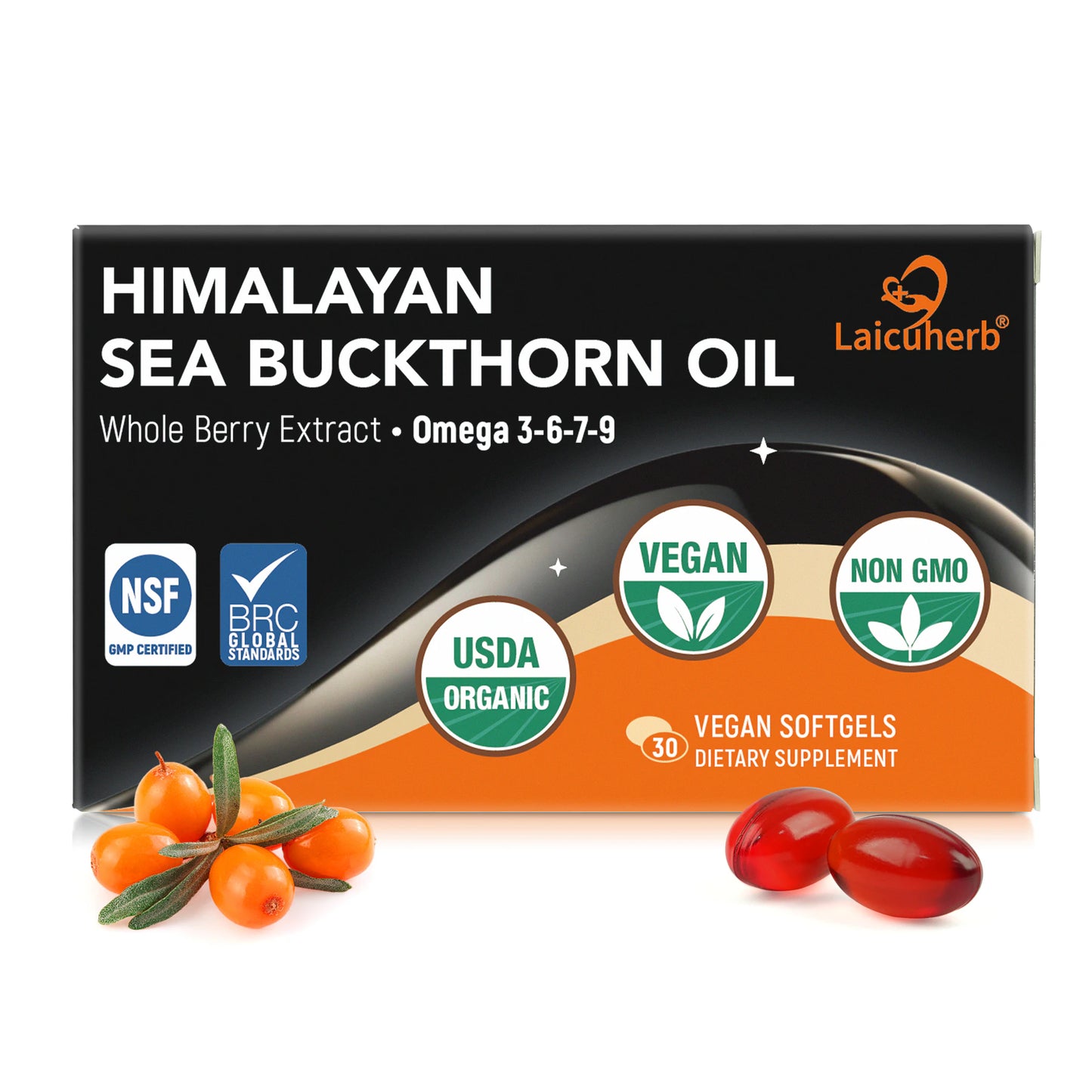
Laicuherb Himalayan Sea Buckthorn Oil is a vegan whole-berry softgel some people take as a daily oral oil: two capsules, 15 servings, 1000 mg oil, with omega-7, omega-9, omega-6, and omega-3 listed on the panel [7]. It is not a cream, not hormone therapy, and not a treatment for post-40 dryness.
In this article
Estrogen and the lipid barrier →
What the papers actually measured →
Quick Answer: Estrogen Decline Is Named Often — It Is Not the Only Driver
Once perimenopause and menopause are in view, estrogen decline is the driver named most often. It is not the only driver, and it does not begin at a fixed birthday.
What the menopause literature describes
Thornton reviewed how estrogen shapes skin and how menopause, which typically arrives around 50, is followed by thinner skin, less collagen, more wrinkling, and more dryness [1]. In that literature, type I and III skin collagen is described as falling by as much as 30% in the first five years after menopause, with further loss of thickness and collagen tied more to years without estrogen than to chronological age alone [1].
What 40 is not
That is a postmenopausal pattern. At 40, some women are already in perimenopause; many are not. Heating, air conditioning, UV, and a cleanser that strips the surface can dry skin at any age. Laicuherb Himalayan Sea Buckthorn Oil supplies a measured serving of whole-berry oil. It does not replace estrogen or rebuild collagen on a percentage schedule.
Three Sources of Post-40 Skin Dryness
Dryness after 40 rarely comes from one cause. It is more useful to notice which of the three is strongest right now than to look for a single product that does all of the work.
Hormones
As ovarian estrogen falls through perimenopause and after menopause, skin can feel thinner and drier, which matches what Thornton summarized [1].
Environment
Years of UV, dry indoor heat, air conditioning, and harsh cleansing wear on the outer barrier, so water leaves more easily.
Lifestyle
Short sleep, low fluid intake, ongoing stress, and medicines such as diuretics can all change how skin feels. Creams and oral oil address different parts of that picture; neither one covers all three sources.
How Estrogen Protects the Lipid Barrier — and What Happens When It Declines
The outer skin, the stratum corneum, is often compared to bricks and mortar: cells as the bricks, and lipids — ceramides, cholesterol, free fatty acids — as the mortar that slows water loss.
Hall and Phillips reviewed estrogen receptors in skin and the skin changes that accompany menopause and hormone therapy [2]. Estrogen is part of how sebaceous activity and dermal structure are maintained. When estrogen falls, that support is quieter. Water can leave the surface more easily, which clinicians describe as transepidermal water loss. The usual sensations are tightness, flaking, slower recovery of small scrapes, and sometimes stinging from a product that used to be comfortable.
If the barrier looks diseased, that is a clinical question. Day to day, the practical stack is still gentle cleansing, a moisturizer that puts lipids back on the surface, sunscreen, and — if you use an oil — a labeled oral serving taken with food. Laicuherb Himalayan Sea Buckthorn Oil is that oral serving. It does not rebuild the lipid barrier on a set timetable.
The Role of Omega-7 Palmitoleic Acid in Skin Membrane Support

Sea buckthorn berries beside an unlabeled cream jar. AI-generated botanical still life, not product packaging.
Palmitoleic acid, the omega-7 on this label, is a fatty acid the body also makes in sebum. Sea buckthorn pulp is one of the uncommon plant sources.
Laicuherb Himalayan Sea Buckthorn Oil is extracted from whole berry, seed and pulp together, so the panel lists omega-7 (324 mg), omega-9, omega-6, and a smaller amount of omega-3 (ALA) per two-capsule serving [7]. The bottle uses supercritical CO2 extraction. That describes how the oil is made; it does not prove those fatty acids arrive intact in facial membranes.
Omega-7 is not established as a shield for mucous membranes, or as an answer to lower sebum after 40. Omega-6, omega-3, and omega-9 each have their own biochemistry, so listing them together is not a clinical combination effect. If you need to know whether this bottle fits a current stack, take the Supplement Facts to the clinician who already follows you, or write hiherbs0129@gmail.com for label details.
Evidence Review: What Studies on Oral Omega-7 and Skin Show
Oral sea buckthorn and facial hydration after 40 is a thin evidence base. The papers people cite are real, and they are easy to over-read.
Yang 2000 — a lab readout
Yang and colleagues measured fatty-acid composition of skin glycerophospholipids in people with atopic dermatitis after months of seed and pulp oils [4]. That is a laboratory readout in a skin-disease group, not a dryness trial in healthy women over 40. Yang 1999 is the related atopic-dermatitis supplementation paper [3].
Larmo 2014 — a different endpoint
Larmo and colleagues gave postmenopausal women 3 g of sea buckthorn oil a day for three months and scored vaginal epithelium, not facial moisture [5]. The Laicuherb serving is 1000 mg, so the dose, endpoint, and product do not carry over.
No published trial shows that this softgel restores skin, reverses age-related change, or outperforms a ceramide cream. Investigators watched oral sea buckthorn for weeks to months in specific groups. Dietary fatty acids can be raw material for membranes. That is not a treatment claim for Laicuherb Himalayan Sea Buckthorn Oil.
Topical vs Oral: Complementary, Not Competing
What a cream does today
Topicals sit on the surface. They replace lipids, hold water with humectants, and slow evaporation. The American Academy of Dermatology still starts dry-skin care with a gentle cleanser, regular moisturizer, and habits that do not strip the face [6]. Daily sunscreen belongs in the same routine because UV is a long environmental load.
What a capsule does later
An oral oil is swallowed, absorbed, and built into tissue over weeks. Laicuherb Himalayan Sea Buckthorn Oil is that slower dietary route. It does not replace today’s moisturizer, and the moisturizer does not replace a labeled oral serving if you have chosen to take one. Using both is a parallel habit, not a proven combination effect.
When to Check Hormones vs. Adjust Nutrition
Not all dryness after 40 is ordinary aging or dry weather. Severity, speed, and accompanying symptoms decide the next step.
See a clinician first
If dryness arrives suddenly or severely with hot flashes, night sweats, irregular bleeding, or a sharp mood shift, that cluster belongs with an OB-GYN or the clinician already managing perimenopause. ACOG treats menopausal symptoms as variable and as a reason for individualized care [8].
Persistent itching, redness, cracking, or a new dry rash can be eczema, psoriasis, allergy, or another dermatologic disease. Those belong with a dermatologist. Changing nutrition or swapping supplements is a poor first move when the skin may need a diagnosis.
Start with habits if it is gradual
Gradual, mild dryness that tracks with heat, travel, or a new cleanser can reasonably start with moisturizer, gentler washing, water, sleep, and — if you use it — the labeled oral oil.
Conclusion
Skin can feel drier after 40. Estrogen decline around menopause is a major piece of that, alongside UV, indoor air, and daily habits. The useful response is still sunscreen, a lipid-rich moisturizer, ordinary hydration, and medical care when symptoms are sudden or severe. Laicuherb Himalayan Sea Buckthorn Oil is a vegan whole-berry softgel, two capsules, 15 servings, 1000 mg oil [7]. Take it as an oral oil next to topical care, not instead of it, and not instead of a clinician when dryness is sudden, severe, or paired with other symptoms.
FAQ
1. Can I take Himalayan Sea Buckthorn Oil daily?
The label is two vegan softgels per serving, 15 servings per bottle, taken as a daily oral oil with a meal that includes some fat [7]. If you are pregnant, nursing, on prescription medicine, or managing a skin disease, take the panel to the clinician who already follows you.
2. Is this product vegan?
Yes. Laicuherb Himalayan Sea Buckthorn Oil is a vegan softgel. The product page also lists Non-GMO and USDA Organic claims for this bottle [7].
3. How is this different from topical sea buckthorn oil?
This product is swallowed. It is not a facial oil and is not for skin, cooking, or any use other than the labeled oral serving [7].
Keep Topical Care First
Laicuherb Himalayan Sea Buckthorn Oil is whole-berry sea buckthorn in a vegan softgel, with omega amounts printed on the panel, and with NSF cGMP, BRC, Non-GMO, USDA Organic, and Vegan claims as listed for this product [7]. Pair the labeled serving with sunscreen and a moisturizer.
Questions on the label: hiherbs0129@gmail.com
References
- Thornton, M. J. (2013). Estrogens and aging skin. Dermato-Endocrinology, 5(2), 264–270. https://pmc.ncbi.nlm.nih.gov/articles/PMC3772914/
- Hall, G., & Phillips, T. J. (2005). Estrogen and skin: The effects of estrogen, menopause, and hormone replacement therapy on the skin. Journal of the American Academy of Dermatology, 53(4), 555–568. https://pubmed.ncbi.nlm.nih.gov/16198775/
- Yang, B., Kalimo, K. O., Mattila, L. M., Kallio, S. E., Katajisto, J. K., Peltola, O. J., & Kallio, H. P. (1999). Effects of dietary supplementation with sea buckthorn (Hippophaë rhamnoides) seed and pulp oils on atopic dermatitis. The Journal of Nutritional Biochemistry, 10(11), 622–630. https://www.sciencedirect.com/science/article/abs/pii/S0955286399000492
- Yang, B., Kalimo, K. O., Tahvonen, R. L., Mattila, L. M., Katajisto, J. K., & Kallio, H. P. (2000). Effect of dietary supplementation with sea buckthorn (Hippophaë rhamnoides) seed and pulp oils on the fatty acid composition of skin glycerophospholipids of patients with atopic dermatitis. The Journal of Nutritional Biochemistry, 11(6), 338–340. https://www.sciencedirect.com/science/article/abs/pii/S0955286300000779
- Larmo, P. S., Yang, B., Hyssälä, J., Kallio, H. P., & Erkkola, R. (2014). Effects of sea buckthorn oil intake on vaginal atrophy in postmenopausal women: A randomized, double-blind, placebo-controlled study. Maturitas, 79(3), 316–321. https://pubmed.ncbi.nlm.nih.gov/25104582/
- American Academy of Dermatology. Dermatologists’ tips for relieving dry skin. https://www.aad.org/public/everyday-care/skin-care-basics/dry/dermatologists-tips-relieve-dry-skin
- Laicuherb. Himalayan Sea Buckthorn Oil. https://www.laicuherb.com/cardiovascular/himalayan-sea-buckthorn-oil
- American College of Obstetricians and Gynecologists. The Menopause Years. https://www.acog.org/womens-health/faqs/the-menopause-years