Why Are My Eyes So Dry? The Mucosal Connection Explained
HiherbsOfficial
Late-afternoon grit is a surface problem first. An oral oil is a diet problem second. Mixing those two jobs is how a search for “why are my eyes so dry” turns into a shopping question it cannot answer.
Dry eye is first a tear-film and ocular-surface issue. Lubricating drops, lid care, and clinic treatments work on that surface. An oral oil works through the diet. Those are different jobs, not competing scores.
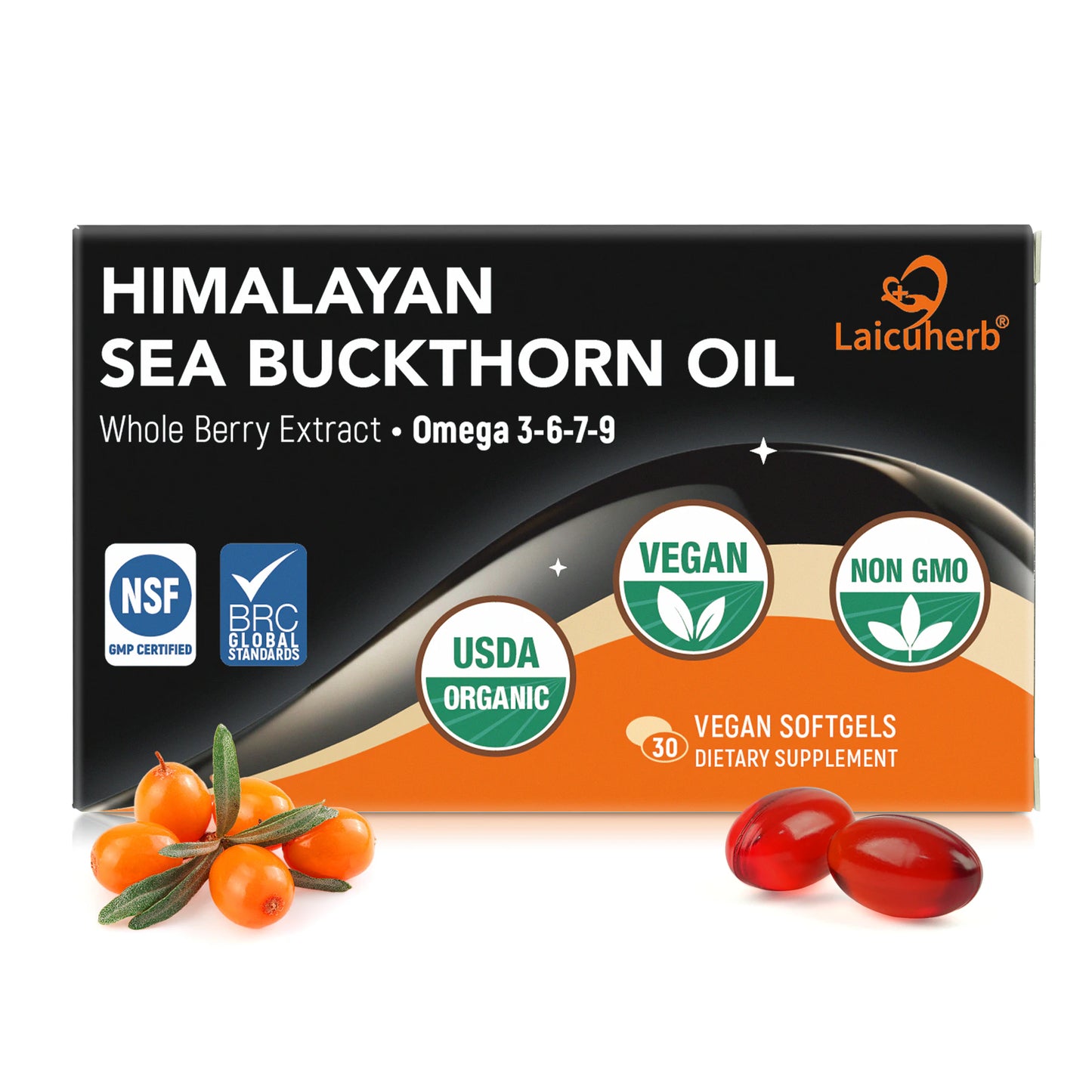
Laicuherb Himalayan Sea Buckthorn Oil is USDA Organic whole-berry oil in vegan softgels: 2 capsules, 1000 mg oil, 324 mg omega-7 (palmitoleic acid) per serving, 15 servings per bottle, CO2-extracted, NSF cGMP and BRC facilities [7]. It is a plant omega supplement. It is not intended to diagnose, treat, cure, or prevent dry eye disease.
Contents
Quick Answer: Two Types of Dry Eye — and Why They Need Different Approaches
Clinicians often describe two overlapping patterns [1][2][4]:
Aqueous-deficient
The lacrimal glands make less of the watery part of tears. Surface hydration is the first conversation — not a capsule score.
Evaporative
The oily layer of the tear film is thin or unstable, so water leaves faster — often linked with meibomian gland function.
Many people have a mix of both [2]. The two patterns are not two flavors of the same capsule. Surface care (drops, lids, prescriptions, in-office gland care when recommended) and oral nutrition sit on different timelines. Which pattern you have is something an eye-care exam can sort. A product page cannot.
Screens, air conditioning, and contact lenses are common everyday loads. Blinking more fully, humidifying the room, and using drops your clinician is comfortable with are practical first steps for many people. If dryness also shows up in the mouth, joints, or elsewhere, or feels severe, that is worth a medical visit so the full picture is not missed.
How the Tear Film Works and Why It Breaks Down
The tear film is a thin coat on the cornea. Mucin helps it spread, the aqueous layer hydrates, and meibomian lipids slow evaporation [1][2][4]. When any layer is off, breakup time shortens and the surface stings.
Screens reduce blink rate. Dry rooms and airflow pull water away. Age, contact lenses, some medicines, and eyelid conditions also matter [1][2]. Office-eye grit has many everyday causes. A nutrient gap is only one possible thread, and it is not assumed as the default.
Researchers who studied oral sea buckthorn oil measured tear-film osmolarity and symptoms in people who already had dry-eye complaints during cold weather [3]. That trial used 2 g/day of a study oil for three months. It describes that study oil and that dose. It is not a certificate that this 1000 mg serving will match those numbers [3][7].
The Mucosal System: Eyes Are Not Isolated

Sea buckthorn berries and water for context. AI-generated scene, not product packaging.
Eyes, mouth, airways, gut, and genital tract all have wet linings. People with dry eyes sometimes also notice a dry mouth. That overlap can come from environment, medicines, aging, or a systemic condition that a clinician names. Shared lining biology is a reason to look at the whole picture. It is not, by itself, proof that one fatty acid restores every mucosa.
If dryness shows up in several places, is new, or is intense, an exam is the honest next step. Autoimmune conditions such as Sjögren’s are diagnoses, not shopping labels. Laicuherb’s oil is whole-berry omegas for a daily plant-oil routine if that is how you use dietary fats in dry seasons [7]. Drops and clinic care remain the surface tools.
What Omega-7 Palmitoleic Acid Does for the Tear Film Lipid Layer
Palmitoleic acid (omega-7) is a monounsaturated fat. Whole sea buckthorn pulp oil is a concentrated plant source. This label lists 324 mg omega-7 per 1000 mg oil serving, with omega-9, omega-6, and ALA [7].
That is composition. Human trials have not mapped a step-by-step path from this capsule into meibum, then into a measured drop in evaporation, on a set calendar. Omega-7 is part of why people look at sea buckthorn oil in this conversation. It is still a food-like fatty acid, not a prescribed tear-film drug.
For serving size, vegan shell, or a batch COA, write hiherbs0129@gmail.com. Osmolarity and diagnosis stay with eye care.
What Clinical Studies Show (and Their Limits)
The dry-eye paper most often cited is Larmo et al., 2010, Journal of Nutrition. A 2014 Larmo trial of sea buckthorn oil measured vaginal atrophy — a different endpoint.
In 2010, oral sea buckthorn oil (2 g/day, 3 months) lessened the cold-season rise in tear-film osmolarity and improved some dry-eye symptoms versus placebo in that study group [3]. That is a real signal for that formula, dose, and season.
Limits still apply: one study oil, not this SKU; weeks of intake, not minutes; not a stand-in for lubrication or in-office care; not a personal results date. TFOS-style care still includes environment, lids, lubrication, and prescription options when they are needed [2]. Oral oil, when used, sits beside that plan.
Oral Supplement vs Eye Drops: Different Jobs
Drops (OTC or prescribed)
Meet the surface in minutes: slip, short comfort, sometimes help with tear osmolarity. Follow the drop label and your clinician.
Oral oils
Go through the gut. In the 2010 trial, the observation window was months, not a lunch break [3]. Keep the supplement at the serving on the bottle.
Both can have a place. They are not substitutes for each other. If you use drops and an oral oil together, do not raise the capsule count on your own to match the 2 g used in a paper [7].
When to See an Ophthalmologist
Book eye care for
Severe or lasting pain, light that hurts, a sudden vision change, thick discharge, trauma, or a red eye that does not look like simple irritation. Dryness that does not ease with ordinary lubrication, or dryness plus dry mouth, swollen glands, or a known autoimmune history, also deserves a workup.
Can run in parallel if you are otherwise stable
A booked appointment and everyday comfort habits. Urgent eye symptoms belong in clinic, not on a longer supplement timeline.
A bottle does not triage red flags. An ophthalmologist or optometrist does.
Conclusion
Dry eyes are a tear-film and ocular-surface issue — evaporative, aqueous-deficient, or mixed [1][2]. Dryness in the mouth or elsewhere is a reason to look more widely with a clinician, not a reason to treat the whole body as one thirsty membrane. Himalayan Sea Buckthorn Oil is a 15-serving vegan whole-berry omega softgel [7]. Larmo 2010 describes a study oil at 2 g/day, not a treatment claim for this bottle [3]. Drops, lid care, and exams stay available. The oil, if you use it, is daily nutrition on its own clock. Product questions: hiherbs0129@gmail.com. Eye symptoms: an ophthalmologist or optometrist.
FAQ
Hiherbs
Laicuherb Himalayan Sea Buckthorn Oil
If grit and screens are the daily load, blinks, air, and surface care still matter. If you also want a plant omega oil in the same routine, this is whole-berry, USDA Organic, 1000 mg oil / 324 mg omega-7 per serving [7]. That is what the label states. Eye-care plans stay with your clinician.
View Himalayan Sea Buckthorn Oil →Label questions: hiherbs0129@gmail.com. Eye symptoms belong with an ophthalmologist or optometrist.
References
- Pflugfelder, S. C., & de Paiva, C. S. (2017). The pathophysiology of dry eye disease: what we know and future directions for research. Ophthalmology, 124(11S), S4–S13. https://pubmed.ncbi.nlm.nih.gov/29055361/
- Craig, J. P., Nichols, K. K., Akpek, E. K., Caffery, B., Dua, H. S., Joo, C. K., Liu, Z., Nelson, J. D., Nichols, J. J., Tsubota, K., & Stapleton, F. (2017). TFOS DEWS II Definition and Classification Report. The Ocular Surface, 15(3), 276–283. https://pubmed.ncbi.nlm.nih.gov/28736335/
- Larmo, P. S., Järvinen, R. L., Setälä, N. L., Yang, B., Viitanen, M. H., Engblom, J. R. K., Viikari, J. S. A., & Kallio, H. P. (2010). Oral sea buckthorn oil attenuates tear film osmolarity and symptoms in individuals with dry eye. Journal of Nutrition, 140(8), 1462–1468. https://pubmed.ncbi.nlm.nih.gov/20573741/
- Nelson, J. D., Shimazaki, J., Benitez-del-Castillo, J. M., Craig, J. P., McCulley, J. P., Den, S., & Foulks, G. N. (2011). The international workshop on meibomian gland dysfunction: report of the definition and classification subcommittee. Investigative Ophthalmology & Visual Science, 52(4), 1930–1937.
- Sullivan, D. A., Rocha, E. M., Aragona, P., Clayton, J. A., Ding, J., Golebiowski, B., Hampel, U., McDermott, A. M., Schaumberg, D. A., Srinivasan, S., Versura, P., & Willcox, M. D. P. (2017). TFOS DEWS II Sex, Gender, and Hormones Report. The Ocular Surface, 15(3), 284–333. https://pubmed.ncbi.nlm.nih.gov/28736336/
- Bron, A. J., de Paiva, C. S., Chauhan, S. K., Bonini, S., Gabison, E. E., Jain, S., Knop, E., Markoulli, M., Ogawa, Y., Perez, V., Uchino, Y., Yokoi, N., Zoukhri, D., & Sullivan, D. A. (2017). TFOS DEWS II Pathophysiology Report. The Ocular Surface, 15(3), 438–510.
- Laicuherb. Himalayan Sea Buckthorn Oil. Product facts as supplied: USDA Organic whole-berry oil in vegan softgels; 2 capsules, 1000 mg oil, 324 mg omega-7 (palmitoleic acid) per serving; 15 servings per bottle; CO2-extracted; NSF cGMP and BRC facilities; plant omega supplement; not intended to diagnose, treat, cure, or prevent dry eye disease. https://www.laicuherb.com/cardiovascular/himalayan-sea-buckthorn-oil
Original article source reference: Laicuherb Editorial. Why Are My Eyes So Dry? The Mucosal Connection Explained. Laicuherb.com.