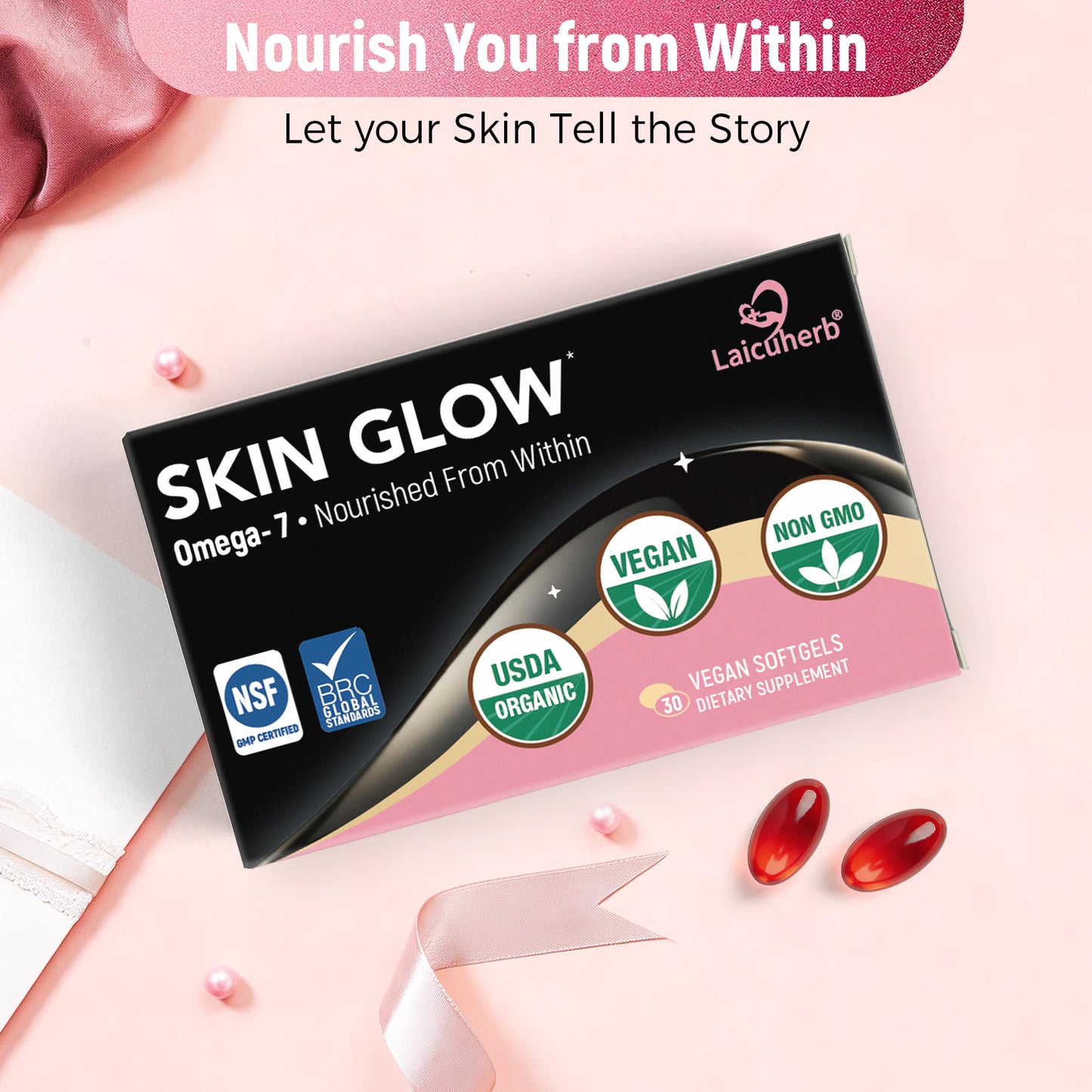
Skin Glow Supplement & Omega-7: What Skin Hydration Studies Show
HiherbsOfficial
By the Hiherbs Editorial Team | Skin Wellness
Contents
- → The Short Answer: Real Evidence, Real Limits
- → How Scientists Measure Skin Moisture
- → Sea Buckthorn, Omega-7, and the Human Evidence
- → What One Study Can and Cannot Tell You
- → The Gap Between Ingredient Research and Your Capsule
- → Tracking Your Own Experience Honestly
- → When Skin Symptoms Call for Professional Attention
- → Conclusion
- → FAQ
At some point, many people hit a wall with topical skincare. The serums accumulate, the routine grows longer, yet the skin still feels compromised — reactive to cold air, tight after cleansing, or simply never quite comfortable. At that point, the idea of an oral supplement starts to make sense: address the variable from a different direction entirely.
Laicuherb Skin Glow Supplement is built around whole sea buckthorn berry extract and oil, which naturally contains Omega-7 (palmitoleic acid) alongside Omega-3, Omega-6, and Omega-9. The ingredient that draws most scientific curiosity here is Omega-7 — not because it promises cosmetic miracles, but because palmitoleic acid happens to be one of the few oral fatty acids that researchers have actually tested against objective, instrument-based skin measurements.
So what does that research show? The honest summary: results are cautiously positive at the ingredient level, and they come with meaningful limitations. This article walks through the evidence without overselling it — because understanding what a study can and cannot prove is what separates informed supplementation from wishful thinking.
The Short Answer: Real Evidence, Real Limits
In 2023, a randomized, double-blind, placebo-controlled trial — the gold standard in clinical research — put oral palmitoleic acid to the test in a group of 90 healthy women over 12 weeks. The supplemented group received 500 mg per day. At the study's endpoint, researchers recorded measurably better skin-hydration scores and lower transepidermal water loss (TEWL) in the palmitoleic-acid group compared to placebo [1].
That finding matters precisely because it uses instruments rather than impressions. It also has clear scope: the same study found no statistically significant group differences for skin elasticity, surface roughness, wrinkle volume, or wrinkle severity. Hydration and barrier function improved; visible aging markers did not.
The calibrated claim
Oral Omega-7 has demonstrated measurable effects on skin hydration and TEWL in a controlled setting — two indicators closely tied to barrier function. That is the science. What the science does not support is promising instant visible radiance, guaranteed dryness relief, or the treatment of any diagnosed skin condition. Laicuherb Skin Glow Supplement is an oral wellness product with transparent sourcing — not a clinical therapy.
How Scientists Measure Skin Moisture
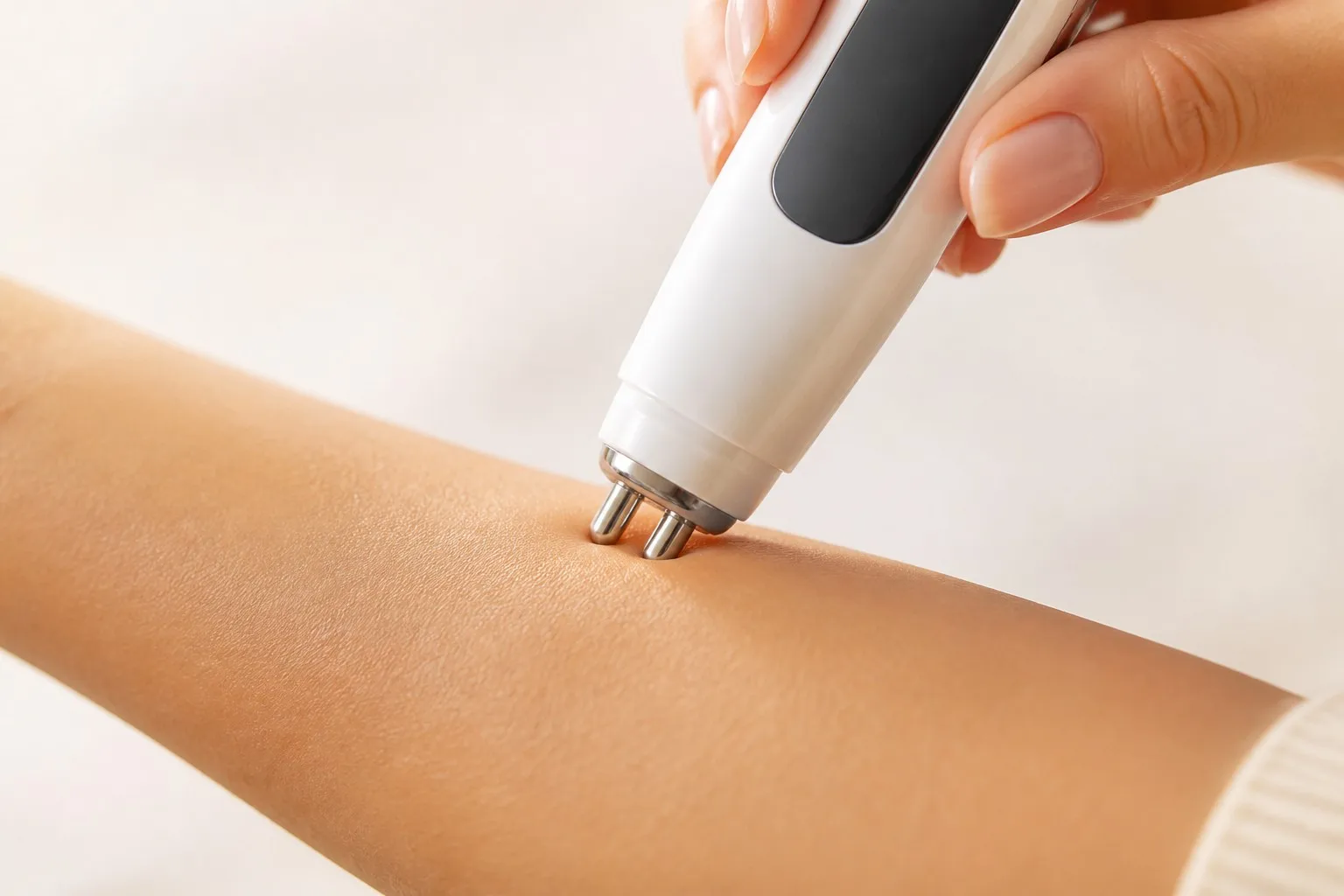
Two instruments dominate skin-hydration research, and understanding what each one actually measures is essential context for reading study results.
Corneometry works by holding a small probe against the skin and measuring an electrical response associated with water content in the stratum corneum — the outermost cellular layer. TEWL (transepidermal water loss) works differently: it quantifies the rate at which water vapor passes outward through the skin. A lower TEWL reading generally indicates a more intact barrier [2]. Together, these two metrics give researchers a paired picture of how much moisture the skin holds and how well it retains it.
Neither number maps directly onto how skin looks or feels to a casual observer. A statistically significant corneometer improvement in a study is not the same thing as visibly plumper skin in a before-and-after photo. That gap between instrument and appearance is important — it is why researchers specifically choose these tools rather than asking participants to rate their own "glow."
It is also worth understanding the difference in how topical and oral products reach the skin. A moisturiser creates an immediate effect at the surface. An oral supplement is metabolised first, then distributed systemically — any influence on skin physiology is indirect and takes time. The two routes are not competing; they are simply answering different questions. Oral studies ask whether a nutrient, once absorbed, produces detectable changes in skin tissue over weeks — not whether it softens skin on contact.
Sea Buckthorn, Omega-7, and the Human Evidence
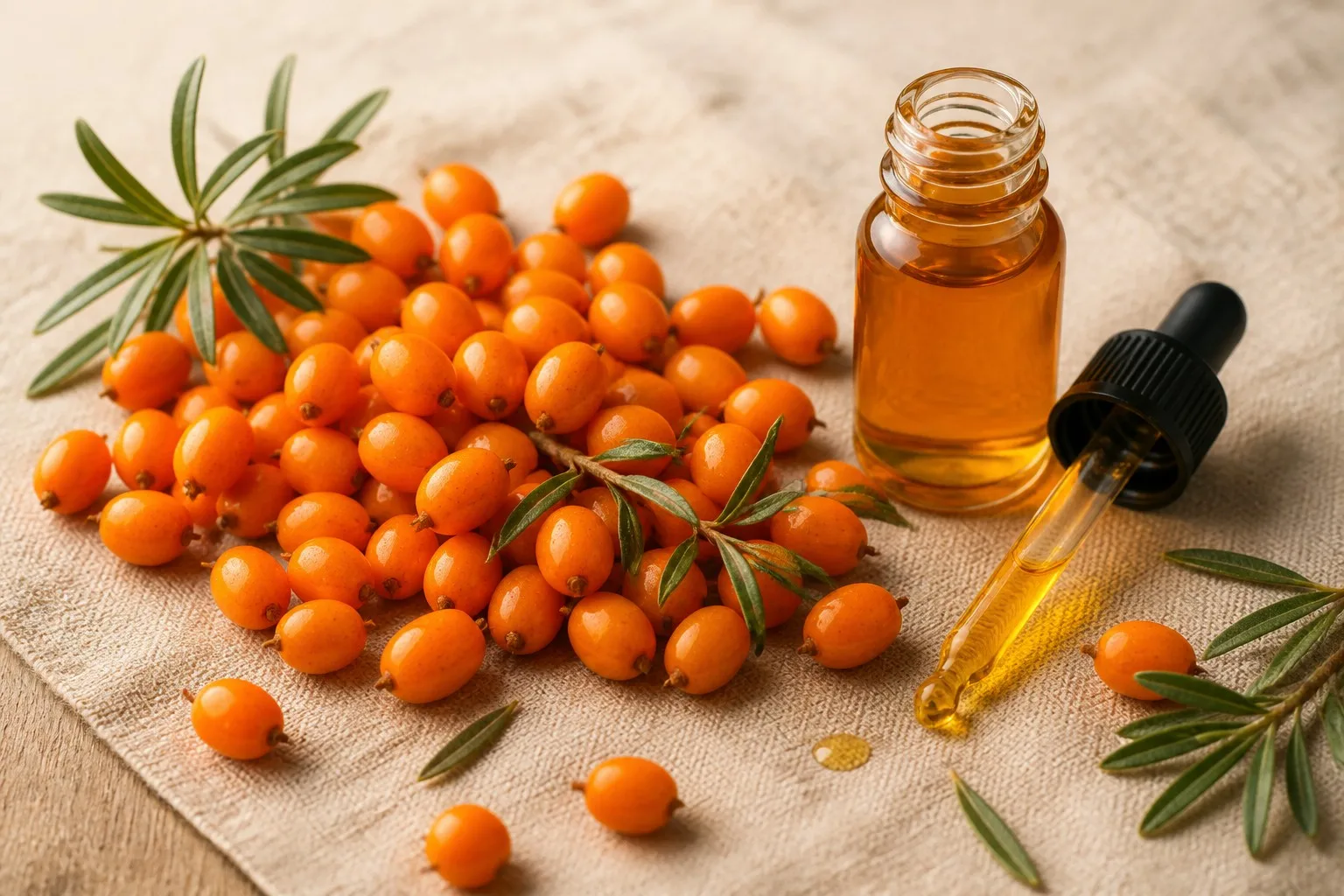
Sea buckthorn has a broad research history, but studies of the whole plant are not automatically transferable to every product derived from it. The most directly relevant data point for skin hydration is the 2023 palmitoleic-acid trial [1], which specifically measured corneometry and TEWL under controlled conditions — the same endpoints discussed above. Among the aging-related outcomes that were measured, hydration and barrier function were the two that showed meaningful group differences.
A separate 2010 study by Larmo et al. involving oral sea buckthorn oil is sometimes referenced in this context. That research focused on tear-film osmolarity in people with dry-eye symptoms — an ophthalmological endpoint, not a skin-hydration outcome [3]. It provides useful background on how sea buckthorn oil behaves in the body, but drawing a straight line from dry-eye results to facial skin moisture involves an inferential jump the data does not support.
Laicuherb Skin Glow Supplement delivers Omega-3, -6, -7, and -9 through whole sea buckthorn berry extract and oil. The ingredient profile is relevant to the research question — palmitoleic acid is present — but the product itself has not been independently tested in the same controlled framework as the 2023 trial. The clinical evidence informs the ingredient rationale; it does not certify the finished capsule.
What One Study Can and Cannot Tell You
A randomized controlled trial with 90 participants and a 12-week follow-up is a credible design. It surpasses testimonials and single-arm studies by a significant margin [1]. At the same time, a single trial — however well designed — establishes a finding in a specific population (healthy women of a particular age range), with a specific formulation, at a specific dose, over a specific period. Those parameters bound what the result means.
The study does not tell us whether results persist beyond 12 weeks, scale with higher doses, replicate in men, or apply to people with eczema, rosacea, psoriasis, or severe clinical dryness. Those populations were not studied, and the outcomes of any supplement trial in healthy subjects should not be extrapolated to diagnosed skin disease without separate research.
For anyone running a personal experiment with this type of supplement, the practical implication is patience. Hold as many other variables as you can — avoid introducing new topical products, switching cleansers, or changing environments mid-trial if possible. Keep a simple log focused on specific sensations: tightness after washing, flakiness at the end of the day, tolerance of cold or dry air. A pattern in a personal record is signal, not proof, but it is more useful than a single impression.
The Gap Between Ingredient Research and Your Capsule
One of the most important distinctions in supplement evaluation is the difference between studying an ingredient and validating a finished product. Clinical research on palmitoleic acid tests a defined preparation under controlled conditions. A commercial sea buckthorn capsule on the other hand involves decisions about extraction method, whether to use whole berry, oil fraction, or a concentrate, the final palmitoleic acid content per serving, and how the product is packaged, stored, and shipped — all of which can affect what actually reaches systemic circulation.
Laicuherb's formulation uses whole sea buckthorn material processed via Supercritical CO₂ extraction — a method chosen to preserve heat-sensitive fatty acids without chemical solvents. That is a meaningful technical choice. It still does not constitute a clinical claim that this specific capsule replicates the study outcomes. Batch-level testing documents such as a COA confirm what is present in the product; they do not substitute for a prospective trial of the finished formulation.
| Due-diligence question | Why it matters when comparing products |
|---|---|
| Whole berry, oil fraction, or isolated extract? | Each form carries a different fatty-acid and phytonutrient profile |
| How many mg of palmitoleic acid per serving? | Dose comparability to the 500 mg/day study preparation is not guaranteed |
| What extraction method was used? | Supercritical CO₂ vs. solvent extraction affects fatty-acid preservation |
| Is third-party batch testing available? | A COA confirms actives and purity at the finished product level |
| How is the product stored before and during shipping? | Unsaturated fatty acids oxidise; packaging and cold-chain handling affect potency |
Tracking Your Own Experience Honestly
Personal observation has value — it just needs to be anchored to something specific. Rather than asking yourself whether your skin looks "glowier," focus on functional observations that mirror what the research actually measured: does skin feel tighter immediately after washing? Is there more or less visible flaking by midday? Does the face feel comfortable in air-conditioned spaces that previously caused irritation? These are proxies for barrier function, not proof of a clinical outcome, but they give you concrete data to weigh over time.
Photograph the same area in the same light on a fixed schedule if you want a visual reference. Note the date, the weather conditions, what moisturiser you used, and whether anything in the environment or routine changed. The goal is not to run a clinical study — it is to have enough structure to tell a pattern from noise. And to be clear: feeling better in your skin after 8 or 12 weeks may be genuinely meaningful, but it is personal information, not transferable proof that the supplement caused it.
When Skin Symptoms Call for Professional Attention
Do not delay medical evaluation if you notice:
- Redness, swelling, or a rash that spreads rapidly or keeps worsening
- Persistent burning, skin cracking, oozing, or crusting
- Symptoms severe enough to disrupt sleep or normal activities
- Involvement of the eyes, lips, or mouth
- Any sign of skin infection — localised heat, pus, or tenderness
- Symptoms that do not respond to a basic, gentle skincare routine over a reasonable period
Conditions such as eczema, atopic dermatitis, psoriasis, rosacea, fungal infections, and drug reactions can all present as generalised dryness or irritation at first. The fact that a supplement is plant-based does not make it diagnostic. A "natural" label is not a substitute for an examination, and no oral supplement — however well-sourced — should delay a dermatology appointment when symptoms warrant one.
Conclusion
Key Takeaways
- A 12-week RCT found that 500 mg/day of oral palmitoleic acid produced measurable improvements in skin hydration and TEWL — two objective indicators of barrier function [1].
- The same study found no significant group differences in skin elasticity, roughness, wrinkle volume, or wrinkle severity.
- This is ingredient-level evidence. Laicuherb Skin Glow Supplement has not been independently tested in a controlled trial; the research informs the ingredient rationale, not the finished product.
- Topical moisturisers and oral supplements work through completely different routes. Neither is inherently superior — they address different aspects of skin physiology.
- If skin symptoms are severe, spreading, or persistent, a qualified clinician's input should come before any supplement decision.
Use the clinical literature to calibrate expectations, use the product label to understand what you are actually taking, and use a dermatologist's expertise when your skin is telling you something beyond ordinary dryness. That combination — honest evidence, accurate product information, and professional input when needed — is more reliable than any single capsule or any single claim.
Frequently Asked Questions
Q1: How long before I might notice a difference?
The controlled trial that provides the most relevant evidence tracked participants at the 6-week and 12-week marks, with statistically significant hydration and TEWL improvements emerging at 12 weeks [1]. That time frame applies to the specific study preparation, not necessarily to every sea buckthorn product — and it says nothing about when or whether visible changes appear. If you decide to trial the supplement, a 10–12 week consistent period with a stable routine gives you the most informative personal data.
Q2: Does taking this mean I can simplify my topical routine?
There is no clinical basis for replacing topical moisturisation with an oral supplement. The two approaches are complementary, not interchangeable — one addresses the skin surface directly, the other works through systemic absorption over time. People with sensitive skin, those taking medication, or those who are pregnant or breastfeeding should discuss any new supplement with a healthcare professional before starting.
Q3: Is this appropriate for eczema or chronic skin conditions?
The 2023 palmitoleic-acid study was conducted exclusively in healthy women without diagnosed skin disease [1]. Its findings do not extend to eczema, atopic dermatitis, psoriasis, or other conditions. Oral supplements are not licensed or validated as treatments for these conditions; managing them requires professional diagnosis and, in many cases, prescription treatment. A supplement may be considered as general wellness support only after the underlying condition has been assessed and, where necessary, medically managed.
Available at Hiherbs
Laicuherb Skin Glow Supplement
Whole sea buckthorn berry extract and oil · Naturally occurring Omega-3, 6, 7 & 9 · Supercritical CO₂ extraction · Plant-based oral capsule
For questions about sourcing, batch documents, or ingredients: hiherbs0129@gmail.com
References
- Koh, Y. G., Seok, J., Park, J. W., Kim, K. R., Yoo, K. H., Kim, Y. J., & Kim, B. J. (2023). Efficacy and safety of oral palmitoleic acid supplementation for skin barrier improvement: A 12-week, randomized, double-blinded, placebo-controlled study. Heliyon, 9(6), e16711. https://doi.org/10.1016/j.heliyon.2023.e16711
- Mayrovitz, H. N. (2023). Transepidermal water loss and stratum corneum hydration in forearm versus hand palm. Skin Research and Technology, 29, e13218. https://doi.org/10.1111/srt.13218
- Larmo, P. S., Järvinen, R. L., Setälä, N. L., Yang, B., Viikari, J. S. A., Engblom, J. R., & Tahvonen, R. L. (2010). Oral sea buckthorn oil attenuates tear film osmolarity and symptoms in individuals with dry eye. The Journal of Nutrition, 140(8), 1462–1468.