Energy Tea vs Matcha: Which Fits a Follicular-Phase Routine? | Hiherbs
HiherbsOfficial
Share
Bleeding days are behind you. Energy is coming back, and the morning cup should not fight that shift. On the counter sit two plant drinks: a tin of matcha, and a box of Laicuherb Pure Energy & Refreshing Tea — green tea with lotus leaf, cassia seed, moringa, and mulberry leaf, sold for the follicular-phase window [4].
Both contain caffeine from Camellia sinensis. One is a single powdered leaf. The other is a five-herb bag you steep. The useful choice is ingredients, caffeine feel, flavor, and whether you want a cycle-tagged ritual — not which cup “wins” hormones.
Contents
Quick Answer: Choose by Ingredients, Caffeine, Flavor, and Routine
Matcha is one ingredient: shade-grown green tea ground to powder. You drink the leaf, not only an infusion. It carries catechins, L-theanine, and caffeine in that powder [3].
Pure Energy & Refreshing Tea is five food-grade herbs in a 3 g sachet: lotus leaf, cassia seed, moringa, mulberry leaf, and green tea [4]. Caffeine comes from the green tea in the blend — not from a published milligram for this bag.
Matcha tastes vegetal and umami. Pure Tea is lighter and herbal. Matcha needs a bowl and a whisk. Pure Tea needs hot water and the bag.
Follicular-phase on the Pure Tea page is a use window after bleeding and before ovulation [4]. It is not evidence that the tea changes estrogen or cycle length.
What Matcha Is
Matcha is green tea (Camellia sinensis) grown in shade, then stone-ground. You whisk the powder into water, so the whole leaf goes into the cup. That is why its catechin and caffeine load tracks how many grams you use, not only steep time [3].
A common home serving is about 1–2 g of powder. Caffeine in matcha is often discussed in a roughly 60–70 mg range per such a serving, but grade, origin, and scoop size move that number. This article did not lab-test a tin, so treat milligrams as a range, not a promise.
L-theanine occurs in tea leaves, including matcha. Small human studies have looked at L-theanine and alertness, and one matcha drink-and-snack trial reported mood and cognitive scores in that setting [1][2]. That is tea research, not a follicular-phase protocol.
Tools are part of the drink: bowl, bamboo whisk, water cooler than a rolling boil. Some people want that ten-minute process. Some do not.
What Pure Energy Tea Is
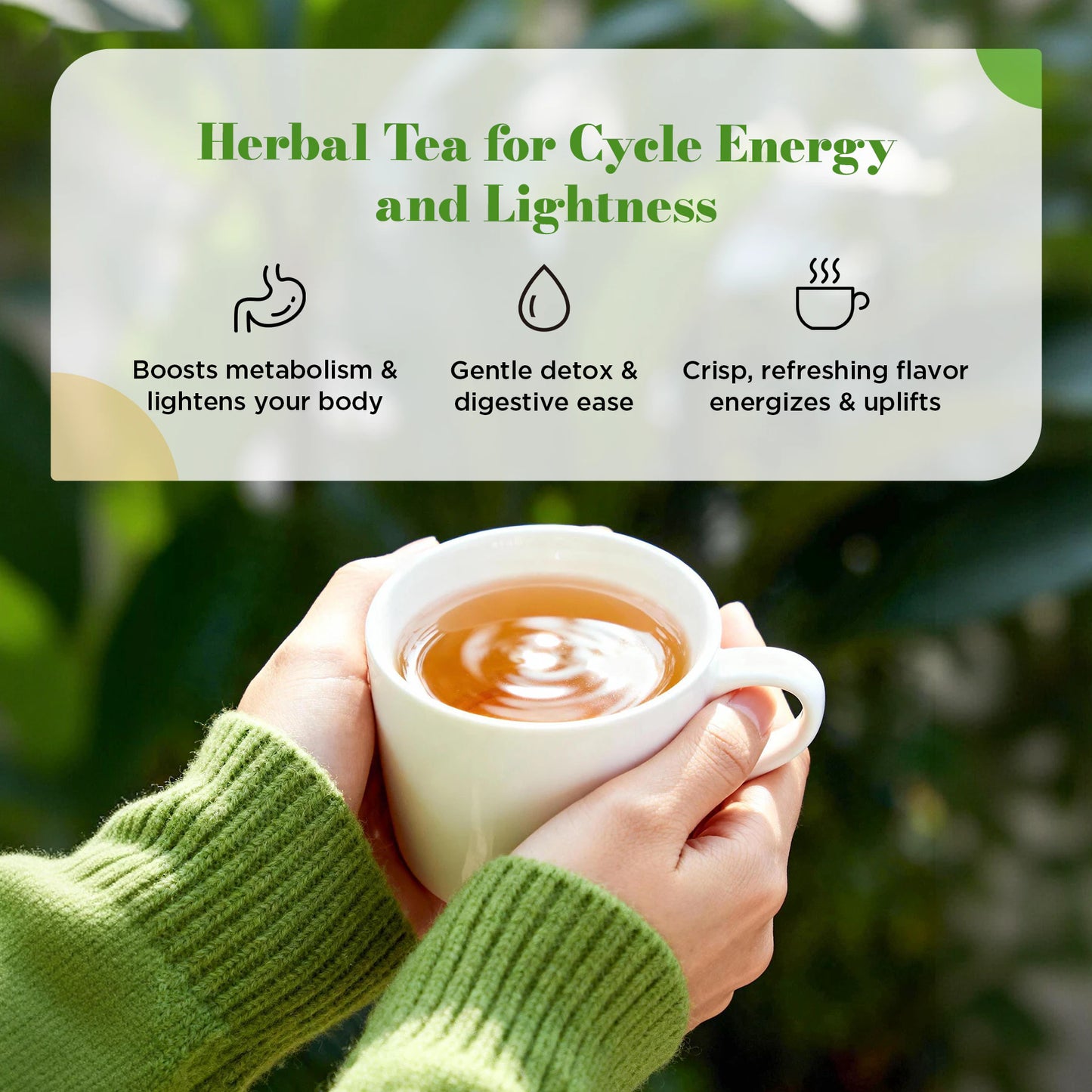
[ Product scene image — update when Laicuherb Pure Energy & Refreshing Tea pack shot is available ]
Laicuherb Pure Energy & Refreshing Tea is a 3 g × 7 bag pack. The label list is lotus leaf, cassia seed, moringa, mulberry leaf, and green tea [4]. Steep one sachet in hot water. It is a beverage.
Green tea supplies caffeine and the familiar tea base. The other four herbs are in the cup for flavor and a traditional herbal profile. They are not a tested stack for metabolism, iron replacement, or hormone support. The live product page is explicit: this is not a detox, fat burner, or weight-loss product, and it is not intended to diagnose, treat, cure, or prevent disease [4].
Taste, as described on that page, is light, refreshing, herbal — not matcha’s thick umami. Certifications listed there: COI, COA, HALAL, ISO-FSSC, HACCP [4]. Follow the package for water temperature and steep time.
Ingredient, sourcing, or blend questions: hiherbs0129@gmail.com.
Comparison Table: Ingredients, Caffeine, Preparation, and Taste
Neither product was caffeine-assayed for this article. Presence is clear. Milligrams are not.
Matcha is a concentrated single leaf. Pure Tea is a multi-herb bag with a cycle label. Different jobs.
What Follicular-Phase Positioning Means
In a textbook cycle, the follicular phase runs from day one of bleeding until ovulation — often about two weeks, often not. Estrogen tends to rise toward ovulation. Many people feel more energy in that stretch. That is a description of a common pattern, not a diagnosis and not a promise that your month will look like a diagram.
Laicuherb puts Pure Tea in that window: after menstruation, before ovulation, as a light daily ritual [4]. The tag tells you when the brand meant you to reach for this box. It does not mean the tea raises estrogen, shortens or lengthens a phase, or “aligns hormones.”
If a phase label helps you choose a box after your period, use it that way. If you want the same matcha every morning, that is also a complete ritual. Neither cup is a hormone intervention.
Who May Prefer Matcha
You want one ingredient and the taste of green tea with no other herbs. You like whisking. You want the same tin in week one and week three.
You also accept that caffeine will scale with how heavy you scoop, and that “calm focus” talk around L-theanine comes from tea research, not from a cycle trial [1][2][3].
Matcha is a poor fit if you hate the grass-and-umami profile, do not want extra gear, or need a caffeine-free cup. Neither drink here is caffeine-free.
Who May Prefer Energy Tea
You want a bag, not a whisk. You like a lighter herbal cup. You already track a cycle and want the follicular-phase box to match those days — as a routine cue, not a medical plan [4].
The five herbs are listed on the pack. Pre-portioned 3 g sachets travel. Caffeine is still there because green tea is in the blend; earlier in the day is the practical move if sleep is fragile [4].
If you are pregnant, breastfeeding, on medication, or managing a condition, ask a clinician before adding a caffeinated herbal tea. Cassia seed is a traditional botanical; the finished bag is still a food, not a laxative protocol.
Conclusion
Both cups get caffeine from green tea. Matcha is the whole-leaf powder: denser, umami, ceremonial. Pure Energy & Refreshing Tea is a five-herb sachet tagged for the follicular-phase mornings after a period [4]. Neither has been shown to change hormones. Pick by taste, gear, caffeine comfort, and whether a phase label is useful to you.
FAQ
Q1: Does Pure Energy & Refreshing Tea contain caffeine?
Yes. The blend includes green tea [4]. Matcha also contains caffeine. Neither option is caffeine-free. If you are sensitive, drink it earlier in the day.
Q2: Is this cup only for the follicular phase, or can it be a daily tea?
The product is positioned for the follicular phase [4]. The ingredients are food-grade herbs used as a beverage. You can drink it on other days if you like the cup. The phase tag is a guide, not a medical restriction.
Q3: Can I whisk matcha into Pure Tea, or drink either cup at night?
Mixing has not been studied. Both contain caffeine, so a combined cup is a larger caffeine load. Evening use may not suit people whose sleep reacts to green tea.
Hiherbs
Laicuherb Pure Energy & Refreshing Tea
Lotus leaf, cassia seed, moringa, mulberry leaf, and green tea in 3 g × 7 sachets, made for a follicular-phase drinks ritual. Certifications listed on the product page: COI, COA, HALAL, ISO-FSSC, HACCP. It is a tea beverage. It does not diagnose, treat, cure, or prevent disease [4].
View Product Page →Label and sourcing questions: hiherbs0129@gmail.com.
References
- Dietz, C., Dekker, M., & Piqueras-Fiszman, B. (2017). An intervention study on the effect of matcha tea, in drink and snack bar formats, on mood and cognitive performance. Food Research International, 99, 72–83.
- Nobre, A. C., Rao, A., & Owen, G. N. (2008). L-theanine, a natural constituent in tea, and its effect on mental state. Asia Pacific Journal of Clinical Nutrition, 17(Suppl 1), 167–168. https://pubmed.ncbi.nlm.nih.gov/18296328/
- Kochman, J., Jakubczyk, K., Antoniewicz, J., Mruk, H., & Janda, K. (2021). Health benefits and chemical composition of matcha green tea: A review. Molecules, 26(1), 85. https://pubmed.ncbi.nlm.nih.gov/33379151/
- Laicuherb. Pure Energy & Refreshing Tea. Product facts as supplied on the current product page (lotus leaf, cassia seed, moringa, mulberry leaf, green tea; 3 g × 7 sachets; follicular-phase positioning; COI, COA, HALAL, ISO-FSSC, HACCP; not a detox, fat burner, or disease treatment).
Original article source reference: Laicuherb Editorial. Energy Tea vs Matcha: Which Fits a Follicular-Phase Routine? Laicuherb.com.