Hormone Balance Tea and Ovulation Tracking: BBT, LH Tests, and Timing
HiherbsOfficial
A hormone balance tea and an ovulation test can share the same morning ritual without answering the same question. That distinction matters — because when a cup of tea lands in the same week as an unusual LH result or a shifted temperature, it is tempting to link the two.
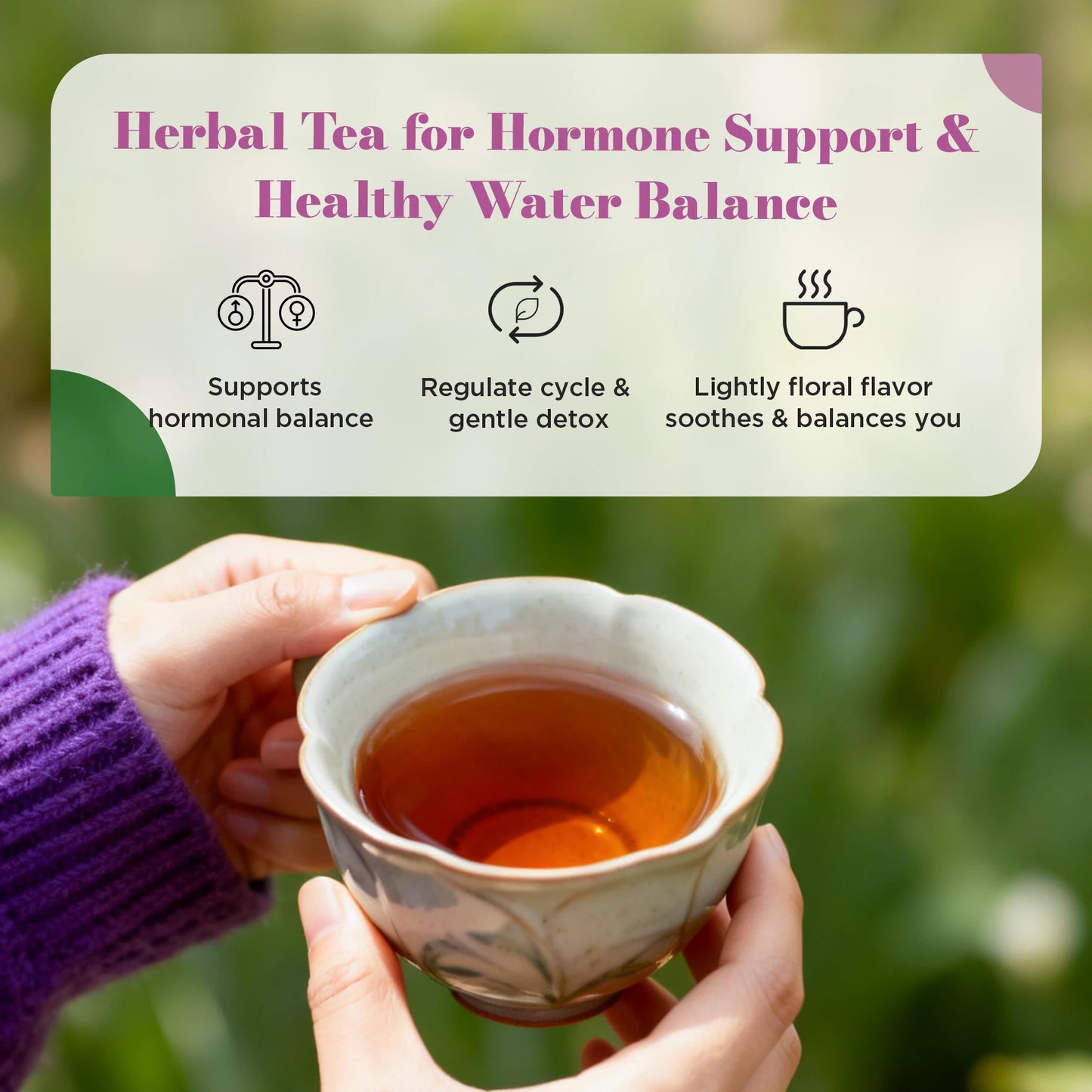
Laicuherb Bloom Hormone Balance Tea is described as a blend for the ovulatory phase, made with rose, ginger, wolfberry, brown sugar, and red dates. Its role is a warm, intentional pause — not a hormone signal. Keeping it separate from your tracking data means you can enjoy the ritual without crediting it for cycle changes it didn't cause.
This guide covers what BBT, LH tests, and cervical-mucus observations can each show, how to log tea use without confusing correlation with cause, and when irregular ovulation needs a clinician rather than a different blend.
Contents
- → Quick Answer: Tea Does Not Confirm Ovulation
- → What BBT Can and Cannot Show
- → What LH Tests Can and Cannot Show
- → How Cervical Mucus Fits — and Its Limits
- → How to Log Tea Use Without Misreading Correlation
- → A Simple Ovulation-Tracking Table
- → When Irregular Ovulation Needs Medical Care
- → Conclusion
- → FAQ
Quick Answer: Tea Does Not Confirm Ovulation
No beverage — including Bloom — confirms that ovulation happened. BBT is retrospective: a sustained rise over several days can suggest ovulation probably occurred after the fact. LH tests detect a hormone surge that often precedes ovulation — a positive result indicates the fertile window may be opening, not that follicular rupture has taken place. Cervical mucus offers a third window, but it is not a standalone confirmation either [1][3].
Bloom can be part of the morning routine around your tracking. What it cannot do is influence the outcome of a test strip, alter BBT in a diagnostically meaningful way, or verify that an egg was released. The cleanest approach: collect the measurement first, record it, then drink the tea. That order protects the data from the comfort ritual.
This matters practically because when a cycle looks different after you start a new tea, the tea becomes the easy explanation. Keeping the fields separate — one for data, one for the ritual — gives you cleaner information to bring to a clinician if a pattern persists.
What BBT Can and Cannot Show

What BBT can show
- A sustained post-ovulation temperature rise over several days
- Retrospective confirmation that ovulation probably occurred [5]
- Cycle-to-cycle patterns across multiple months
- An approximate luteal phase length
What BBT cannot show
- Advance warning hours before ovulation
- Proof from a single temperature reading
- Readings unaffected by fever, alcohol, travel, or poor sleep
- Results from an oral reading taken after hot tea
The practical rule is that BBT tells you where you probably were in the cycle — not where you are going next. The temperature is taken immediately after waking, before any movement, ideally after a consistent sleep window and under similar conditions each day [5].
Drinking hot Bloom immediately before an oral temperature reading will affect that measurement. The sequence that protects the data: wake → temperature → record → tea. The beverage is a reward for consistency, not a morning variable to ignore.
What LH Tests Can and Cannot Show
Urinary ovulation predictor kits detect luteinizing hormone. An LH surge typically precedes ovulation by approximately 24–36 hours, which is why a positive result indicates that the fertile window may be opening or approaching — not that follicular rupture has already occurred [6]. A positive line tells you something about hormone timing. It does not guarantee that an egg will be released.
Important caveats for LH testing
- Fluid intake before testing can dilute urine and suppress an LH rise. Follow the specific kit's instructions for hold time and dilution — do not dehydrate yourself to chase a darker line.
- PCOS and other cycle patterns can elevate baseline LH or produce multiple apparent positives. In these cases, LH strips alone are harder to interpret and clinical guidance is more useful.
- Rose, ginger, wolfberry, brown sugar, and red dates have not been shown to alter urinary LH. Drinking Bloom will not turn a negative strip positive.
Follow the test's instructions precisely for timing, sample collection, and result interpretation. If results are consistently ambiguous or your cycles are very irregular, the information is more useful in a clinical conversation than as self-managed data.
How Cervical Mucus Fits — and Its Limits
As estrogen rises during the follicular phase, cervical mucus often shifts from sticky or absent toward a wetter, clearer, more slippery or stretchy consistency. Recognising this pattern is the basis of cervical-mucus observation as a fertility-awareness method [2]. It provides information about the cycle before ovulation — a timing advantage that BBT alone doesn't offer.
The limits are real. Infection, medication, hormonal contraception, stress, dehydration, semen, and lubricants can all alter what you observe. Some people see little fertile-quality mucus even in ovulatory cycles. Others see a fertile pattern in a cycle that doesn't result in ovulation [2][3]. The observation is a signal worth recording — it is not a standalone confirmation.
Keep Bloom out of the interpretation column. The brown sugar and red dates in the blend have no relationship to cervical fluid. Recording whether you drank the tea as a separate field — not as a fertility observation — keeps your dataset cleaner.
How to Log Tea Use Without Misreading Correlation
New habits tend to become convenient explanations. If a cycle looks different in the weeks after you start Bloom, the tea is the obvious candidate — even though sleep changes, seasonal stress, a minor illness, weight shifts, thyroid variation, or simple normal-cycle variability could each account for the same observation.
The practical solution is column separation. Your tracking record should have distinct fields for BBT, LH result, cervical mucus, sleep quality, illness, and other symptoms — and a separate field for whether you drank Bloom that day. When you review the log after a few cycles, you can read each column on its own terms rather than through the lens of a single new variable.
One or two observations that follow tea use show correlation at most — not that the blend changed ovulation timing, LH levels, progesterone, fertility, or cycle length. For product questions, contact hiherbs0129@gmail.com. Medical interpretation of cycle data belongs with a qualified clinician.
A Simple Ovulation-Tracking Table
The table below separates observational fields from the tea field. It is not a diagnostic tool — it is a way to notice patterns across cycles without merging different types of information.
| Date | BBT | LH Result | Mucus | Tea used | Notes |
|---|---|---|---|---|---|
| Oct 1 | 97.3°F | Negative | Sticky | None | Woke late |
| Oct 2 | 97.3°F | Negative | Creamy | Bloom | Stressful day |
| Oct 3 | 97.2°F | Positive | Stretchy | Bloom | Tested at 2 p.m. |
| Oct 4 | 97.3°F | Positive | Stretchy | Bloom | Mild cramps |
| Oct 5 | 97.5°F ↑ | Negative | Wet | Bloom | Temperature rose |
| Oct 6 | 97.6°F | Negative | Dry | None | Slept 9 hours |
| Oct 7 | 97.6°F | Negative | Dry | Bloom | Premenstrual mood change |
The Tea used column is observational data — not an interpretation column. A tea entry records a habit. It does not explain the BBT rise on Oct 5 or confirm that the LH positives on Oct 3–4 led to ovulation. App predictions are useful reminders, but they estimate cycle patterns — they are not measurements. After two or three cycles, bring an unclear or persistently irregular record to a clinician.
When Irregular Ovulation Needs Medical Care
Occasional anovulation happens across a range of normal and non-normal cycles. It is the persistent or worsening pattern that warrants clinical attention. Consider contacting a healthcare professional if you notice:
Cycle pattern concerns
- Three or more missed periods in a row
- Cycles repeatedly shorter than 21 days or longer than 35 days
- A cycle pattern that is new and persistent
- LH test results that are consistently ambiguous or difficult to interpret
Additional symptoms
- New or severe pelvic pain
- Unusually heavy or prolonged bleeding
- Multiple LH positives that don't follow an expected pattern
- Cycle changes after a new medication or health event
Anovulation and PCOS cannot be diagnosed from a BBT chart, an LH strip, a tea, or an app. A clinician will consider cycle history, blood tests, possible ultrasound, and other information to build a picture. Bloom can be a comforting part of the routine while you wait for an appointment — but it should not delay evaluation or be treated as a fertility intervention.
The right thresholds for seeking care also depend on your age, reproductive stage, medications, and what you are trying to understand or plan. If the cycle pattern is confusing or feels new, that alone is a reasonable reason to ask.
Conclusion
Three things to carry forward
- Tracking tools each have a specific job. BBT is retrospective. LH tests detect a surge, not a confirmation of release. Cervical mucus adds a real-time window. None of the three is replaced or improved by a beverage.
- Column separation protects your data. Tea use belongs in its own field — not in the interpretation column. Recording and interpreting are different acts.
- Bloom is a ritual, not a regulator. Use it as a warm, intentional habit aligned with your cycle phase. Follow your test instructions, log the data separately, and bring persistently irregular patterns to a clinician.
Laicuherb Bloom Hormone Balance Tea is described as a rose, ginger, wolfberry, brown sugar, and red-date blend for the ovulatory phase — a comfort ritual. That is its place in a tracking routine: adjacent to the data, not inside it.
FAQ
Hiherbs
Laicuherb Bloom Hormone Balance Tea
Ovulatory phase blend · Rose · Ginger · Wolfberry · Brown Sugar · Red Dates · 7 sachets × 3 g
View Product Page →Questions about ingredients, sourcing, or quality documentation:
hiherbs0129@gmail.com
If ovulation seems absent, cycles remain irregular, or test results are difficult to interpret, speak with a qualified healthcare professional. This product is not intended to diagnose, treat, cure, or prevent disease.
References
- Su, H. W., Yi, Y. C., Wei, T. Y., Chang, T. C., & Cheng, C. M. (2017). Detection of ovulation: A review of currently available methods. Bioengineering & Translational Medicine, 2(3), 238–246.
- Najmabadi, S., Schliep, K. C., Simonsen, S. E., Porucznik, C. A., Sobel, E., & Stanford, J. B. (2020). Cervical mucus patterns and the fertile window in women not using any contraception. Journal of Women's Health, 29(12), 1554–1561.
- Ecochard, R., Duterque, O., Leiva, R., Bouchard, T., & Vigil, P. (2015). Self-identification of the clinical fertile window and the ovulation period. Fertility and Sterility, 103(5), 1319–1325.
- Blackwell, L. F., Brown, J. B., Vigil, P., Gross, B., Sufi, S., & d'Arcangues, C. (2013). Hormonal monitoring of ovarian activity using the Ovarian Monitor, part I. Human Reproduction, 28(3), 750–758.
- Barron, M. L., & Fehring, R. J. (2005). Basal body temperature assessment: Is it useful to couples seeking pregnancy? Journal of Obstetric, Gynecologic, and Neonatal Nursing, 34(2), 254–260.
- Direito, A., Bailly, S., Mariani, A., & Ecochard, R. (2013). Relationships between the luteinizing hormone surge and other characteristics of the menstrual cycle in normally ovulating women. Frontiers in Public Health, 1, 53.
Original article source reference: Laicuherb Editorial. Hormone Balance Tea and Ovulation Tracking: BBT, LH Tests, and Timing. Laicuherb.com.