Himalayan Sea Buckthorn Oil: Supercritical CO2 vs Cold-Pressed
HiherbsOfficial
When you compare sea buckthorn oils, the extraction method is usually one of the first details you notice. One label says cold-pressed. Another says supercritical CO2. Both sound promising, but the method alone does not tell you everything about the oil in the bottle. The berries themselves matter. So do the part of the berry used, the harvest conditions, the processing controls, the final fatty-acid profile, and the testing behind the label. A carefully made cold-pressed oil may be a good product. A CO2-extracted oil still needs to show what it contains through clear specifications and batch testing. Laicuherb’s Himalayan Sea Buckthorn Oil is made from wild-harvested whole berries gathered at high altitude in the Himalayas and extracted with supercritical CO2. According to the product information supplied for this article, each serving provides 1,000 mg of organic sea buckthorn oil and 324 mg of omega-7 in vegan softgels. This guide explains how supercritical CO2 and cold pressing differ, what each method can reasonably tell you, and what to check before you decide.
Explorer Directory
- 01 Quick Answer: The Methods Differ, but Quality Depends on More Than Extraction
- 02 How Cold Pressing Works
- 03 How Supercritical CO2 Extraction Works
- 04 Comparison Table: Temperature, Oxygen, Solvents, and Yield
- 05 What Each Method May Preserve—and What Cannot Be Assumed
- 06 How Whole-Berry vs Seed-Only Material Changes the Comparison
- 07 How to Read Extraction Claims on a Label
- 08 Product Spotlight: Laicuherb Himalayan Sea Buckthorn Oil
- 09 Frequently Asked Questions
- 10 References
Quick Answer: The Methods Differ, but Quality Depends on More Than Extraction
Cold pressing and supercritical CO2 extraction use different ways to remove oil from plant material. Cold pressing relies on mechanical force. The berries or berry material are prepared and pressed, and the oil is separated from the remaining solids. Supercritical CO2 extraction uses carbon dioxide under controlled pressure and temperature. In that state, CO2 can move through the plant material and dissolve oil compounds. When the pressure is released, the carbon dioxide separates from the oil.
Neither method automatically produces a universally better sea buckthorn oil. The final result also depends on the quality and freshness of the berries, whether the product uses seed, pulp, or whole-berry material, how the oil is handled after extraction, and whether an independent laboratory verifies the finished batch.
For Laicuherb’s Himalayan Sea Buckthorn Oil, the relevant product details are the whole-berry starting material, the supercritical CO2 process, the stated omega profile, and the available quality documentation. The extraction method helps explain how the oil is made. It is not, by itself, proof of a health outcome.
How Cold Pressing Works
Cold pressing is a mechanical extraction method. After the sea buckthorn berries are cleaned and prepared, a press applies force to the plant material and releases the oil. The method does not add a chemical solvent, which is one reason it appeals to people who prefer a straightforward, minimally processed approach.
The word “cold” needs a little context. Pressing creates friction, and the temperature of the material can vary with the equipment, pressure, speed, moisture level, and length of processing. A responsible label should explain how the producer defines and controls its processing temperature rather than treating the word “cold” as a complete quality report.
Cold pressing can retain a broad mixture of oil components because it does not selectively target one fatty-acid fraction. That can be useful when the goal is a less refined oil with the characteristics of the starting material. It can also make the finished oil more dependent on filtration, storage, oxygen exposure, and the quality of the berries used.
The oil may contain naturally occurring fatty acids, pigments, sterols, waxes, and other compounds from the fruit or seed material. Some of those compounds may contribute to the oil’s color and character. Others can affect clarity, flavor, oxidation, or shelf stability. The important question is not whether the oil was pressed. It is whether the producer controls those variables and verifies the final product.
How Supercritical CO2 Extraction Works
Supercritical CO2 extraction uses carbon dioxide under conditions above its critical temperature and pressure. In this state, CO2 has properties of both a gas and a liquid. It can pass through prepared plant material and carry oil-soluble compounds away from it.
Once the pressure is reduced, the CO2 separates from the extracted oil. This is different from an extraction process that leaves a liquid organic solvent in contact with the finished product. Even so, the finished oil should still be tested. “CO2 extracted” describes a process; it does not replace a Certificate of Analysis.
One advantage of a controlled CO2 system is that the producer can manage pressure, temperature, time, and the characteristics of the material being extracted. Depending on those parameters, the process may be adjusted toward different fractions of the raw material. That does not mean every CO2-extracted oil has the same composition, or that CO2 extraction preserves every nutrient better than pressing.
Research on sea buckthorn extraction has reported differences in the concentration of compounds such as carotenoids and tocopherols under different extraction conditions [5][6]. Those findings are useful when discussing processing, but they should not be stretched into a universal claim that supercritical CO2 always produces a healthier oil. The raw material and the extraction settings still matter.
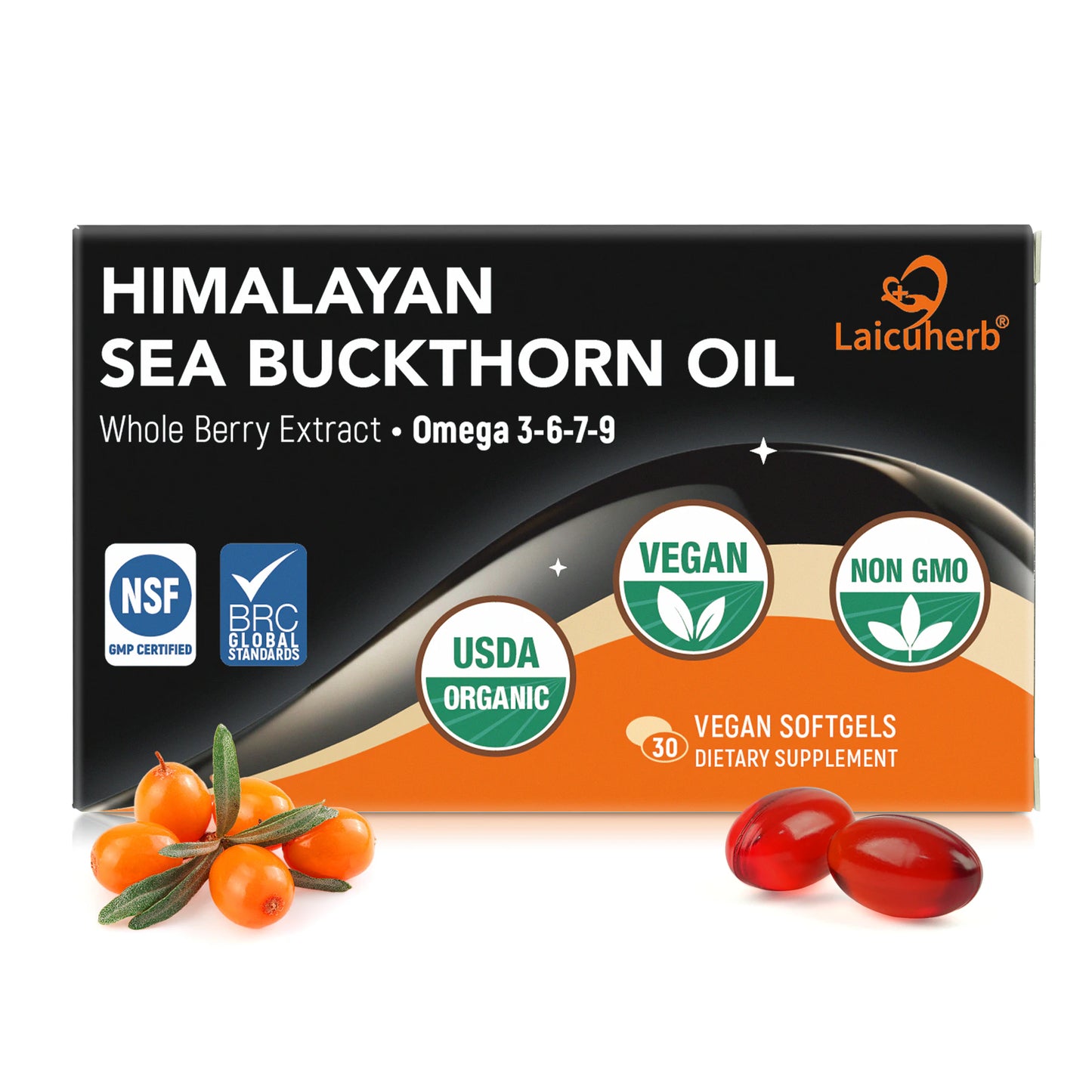
Laicuherb uses supercritical CO2 for its Himalayan sea buckthorn oil and describes the product as a whole-berry extract. The supplied product information lists 1,000 mg of organic sea buckthorn oil and 324 mg of omega-7 per serving. Those are measurable label details. They are more useful to a buyer than a broad statement that one extraction method is simply “the best.”
Comparison Table: Temperature, Oxygen, Solvents, and Yield
| Parameter | Cold Pressing | Supercritical CO2 |
|---|---|---|
| Main principle | Mechanical pressure releases oil from prepared plant material | Pressurized carbon dioxide carries oil-soluble compounds from the plant material |
| Added organic solvent | No | No organic solvent; CO2 separates during depressurization |
| Temperature control | Depends on equipment, friction, moisture, and processing conditions | Controlled by the producer’s pressure and temperature settings |
| Oxygen exposure | Depends on the press and handling environment | Often processed in a closed system, though post-extraction handling still matters |
| Selectivity | Generally produces a broad pressed oil rather than a targeted fraction | Parameters can be adjusted to influence the extracted fractions |
| Oil yield | Varies with berry part, moisture, equipment, and pressing conditions | Varies with raw material, particle size, pressure, temperature, and process design |
| Main quality docs | Fatty-acid profile, oxidation values, contaminants, and batch COA | Fatty-acid profile, oxidation values, contaminants, residual testing, and batch COA |
The main difference is process control, not a guaranteed ranking. Cold pressing can be relatively simple and transparent when the producer explains the process and tests the oil properly. Supercritical CO2 can offer tighter control over extraction conditions, but the equipment and parameters are more complex. In both cases, the buyer still needs to look at the product’s actual specifications.
Shelf stability is another area where broad claims can become misleading. Oxygen exposure, moisture, light, packaging, antioxidant content, and storage conditions all influence how an oil holds up over time. A closed extraction system may reduce oxygen exposure during one stage of production, but it does not guarantee a longer shelf life after the oil has been packaged. Peroxide value, storage guidance, and batch testing provide better evidence.
What Each Method May Preserve—and What Cannot Be Assumed
Both methods can preserve some naturally occurring compounds, but the result depends on the exact process. Sea buckthorn oil contains fatty acids and may also contain carotenoids, tocopherols, plant sterols, and other lipid-soluble compounds. Heat, oxygen, light, moisture, and processing time can affect these components.
Some studies have found that supercritical CO2 extraction can produce sea buckthorn oils with notable levels of carotenoids or tocopherols under particular conditions [5][6]. That is a finding about those studies and those parameters. It is not proof that every CO2-extracted oil will contain more of every nutrient than every cold-pressed oil.
Vitamin C requires separate consideration because it is water-soluble and is not distributed in oil in the same way as lipid-soluble compounds. A producer should not imply that an oil capsule contains high levels of vitamin C unless the finished product has been tested and the amount is stated clearly on the label.
For Laicuherb’s product, the supplied information lists 324 mg of omega-7, 1.5 mg of vitamin E, and 500 mcg of natural carotenoids per serving. Those values should be understood as product-specific specifications, not as a general result of CO2 extraction. The strongest way to support them is a current supplement facts panel and a batch-specific COA.
The practical lesson is simple. An extraction method can influence what an oil contains, but only testing can tell you what is present in the batch you are considering. A CO2 claim without a fatty-acid profile is incomplete. A cold-pressed claim without oxidation and contaminant testing is incomplete too.
How Whole-Berry vs Seed-Only Material Changes the Comparison
The starting material can change the finished oil as much as the extraction method. Sea buckthorn seed oil and pulp oil do not have identical fatty-acid profiles. Seed oil is commonly associated with linoleic acid and alpha-linolenic acid, while pulp or fruit oil is often associated with palmitoleic acid and carotenoids [1].
That is why “whole berry,” “seed oil,” and “pulp oil” are not interchangeable label terms. A CO2-extracted seed oil may have a different nutritional profile from a cold-pressed whole-berry oil. The same extraction method can produce different results when the raw material changes.
Laicuherb’s Himalayan Sea Buckthorn Oil is described as a whole-berry extract. The supplied product information lists 324 mg of omega-7, 245 mg of omega-9, 103 mg of omega-6, and 22 mg of omega-3 per serving. Those figures represent the stated profile of this product, including contributions from different parts of the berry. They should not be used as a general profile for every Himalayan sea buckthorn oil. When comparing products, look for the exact source material and the amount of each fatty acid. If a label only says “sea buckthorn oil” without clarifying whether it comes from the seed, pulp, or whole berry, you have less information for making a meaningful comparison.
How to Read Extraction Claims on a Label
Extraction language can be useful, but it is easy for it to become a shortcut for quality. Start by checking whether the label names the method clearly: cold-pressed, solvent-extracted, supercritical CO2, or another process. Then check whether the producer identifies the part of the berry used and provides a complete supplement facts panel.
Next, look for testing that relates to the finished product. A batch-specific Certificate of Analysis may include the fatty-acid profile, carotenoid and tocopherol levels where relevant, peroxide or other oxidation values, heavy metals, pesticides, and microbiological results. The exact tests depend on the product and the laboratory, but the report should identify the tested batch.
For Laicuherb’s Himalayan sea buckthorn oil, the supplied product information lists NSF cGMP and BRC certifications and states that batches are analyzed for impurities. It also lists USDA Organic, Non-GMO, and Vegan attributes. Before publication or purchase, verify the current certification wording and the available documents for the specific product. Finally, read the extraction claim in proportion. Supercritical CO2 can tell you something about how the oil was produced. It cannot, on its own, prove that the product will treat dryness or produce a particular medical result. The label, the COA, the raw-material description, and the storage instructions should all support the quality story.
Product Spotlight: Laicuherb Himalayan Sea Buckthorn Oi

Frequently Asked Questions
Does supercritical CO2 extraction leave solvents in Himalayan sea buckthorn oil?
Supercritical CO2 is used as the extraction medium and separates from the oil when pressure is released. It is different from an organic solvent that remains in the product. Even so, consumers should look for a current batch-specific COA and any applicable residual or contaminant testing rather than relying on the extraction claim alone.
How extraction temperature affects the color and freshness of Himalayan sea buckthorn oil?
Temperature can affect sensitive compounds, but the outcome depends on the actual time, temperature, oxygen exposure, raw material, and post-extraction handling. Carotenoids contribute to sea buckthorn oil’s characteristic color, while light, oxygen, and storage conditions can affect freshness. Cold pressing can generate friction heat, and CO2 extraction uses controlled conditions, but neither label term alone proves a particular nutrient-retention result.
What should a COA include for Himalayan sea buckthorn oil, and how can I verify freshness?
A useful COA may include the fatty-acid profile, carotenoid or tocopherol results where relevant, peroxide or other oxidation values, heavy metals, pesticide residues, and microbiological testing. It should identify the tested batch and the laboratory that performed the analysis. Storage instructions, packaging, lot information, and the product’s expiration or best-before date also help you assess freshness. Laicuherb states that it performs batch-specific testing and operates with NSF cGMP and BRC certification; check the current product documents for the details that apply to your batch.
Global Sourcing & Safety Standards
USDA Organic • Non-GMO • Vegan • NSF cGMP Certified • EU BRC Certified