Feminine Moisture Supplement vs Topical Moisturizer: Oral vs Local Support
HiherbsOfficial
Intimate dryness can show up during perimenopause, after childbirth, while breastfeeding, after a procedure, or during an ordinary stretch of stress. The word “dryness” sounds simple. The reason behind it may not be. That is why a product comparison should start with function, not a promise. A topical vaginal moisturizer is applied locally and is designed to help the tissues feel more comfortable over time. An oral feminine moisture supplement is swallowed and enters a different pathway through digestion and systemic absorption. These are not two versions of the same product. They have different routes, different evidence, and different reasons someone may choose to discuss them with a healthcare professional. Laicuherb Feminine Moisture Support is described as a plant-based vegan softgel containing whole sea-buckthorn oil, with naturally occurring Omega-7, Omega-3, Omega-6, and Omega-9 listed in the supplied product information. It is a non-hormonal oral wellness supplement, not a topical product and not a treatment for vaginal dryness or genitourinary syndrome of menopause. This guide compares the two formats without pretending that one product can answer every cause of intimate discomfort.
Explorer Directory
- 01 Quick Answer: Oral Supplements and Topical Moisturizers Work in Different Ways
- 02 What Topical Vaginal Moisturizers Are Designed to Do
- 03 What an Oral Sea-Buckthorn Supplement Is
- 04 Comparison Table: Key Differences at a Glance
- 05 Why Neither Option Is a Universal Replacement
- 06 How to Choose Based on Symptoms and Professional Advice
- 07 When Intimate Dryness Needs Medical Evaluation
- 08 Product Spotlight: Laicuherb Feminine Moisture Support
- 09 Frequently Asked Questions
- 10 References
Quick Answer: Oral Supplements and Topical Moisturizers Work in Different Ways
Topical vaginal moisturizers are used in or around the vaginal area to provide local comfort and reduce the feeling of dryness. Depending on the formula, they may contain ingredients such as hyaluronic acid or other moisturizing agents. They are different from lubricants, which are generally used to reduce friction during sexual activity.
An oral feminine moisture supplement is taken by mouth. Its ingredients are digested and absorbed through the body rather than placed directly on vaginal tissue. That route may be convenient for someone who prefers a daily softgel, but it does not make the supplement a local moisturizer. It also does not prove that the product changes vaginal tissue, hormone levels, or symptoms.
The 2025 AUA/SUFU/AUGS guideline addresses evaluation and management of genitourinary syndrome of menopause and grades recommendations according to the available evidence [1]. Its treatment framework should not be reduced to a claim that all oral supplements work—or that they do not work for every possible formulation. The relevant consumer takeaway is narrower: evidence for a specific oral supplement must be judged separately from evidence for topical moisturizers, prescription treatments, or the sea-buckthorn ingredient in a particular study.
What Topical Vaginal Moisturizers Are Designed to Do
Topical vaginal moisturizers are intended for regular local use rather than only for the moment of sexual activity. They may help reduce the sensation of dryness or irritation by adding moisture to the area. Lubricants serve a different purpose: they are used during sexual activity to reduce friction and may act more quickly for that specific situation [2].
The formula matters. People with sensitive tissue may prefer products with clear ingredient lists and without unnecessary fragrance or irritating additives. Product pH and osmolality can also matter for vaginal comfort, but a label claim is not the same thing as an independent quality assessment. Follow the product directions and stop if burning, rash, pain, or another concerning reaction develops.
A topical moisturizer acts at the application site. Laicuherb Feminine Moisture Support is swallowed. It should not be described as an oral moisturizer that “hydrates the surface from within.” That phrase sounds neat, but it skips the physiology and overpromises what a supplement can show.
What an Oral Sea-Buckthorn Supplement Is
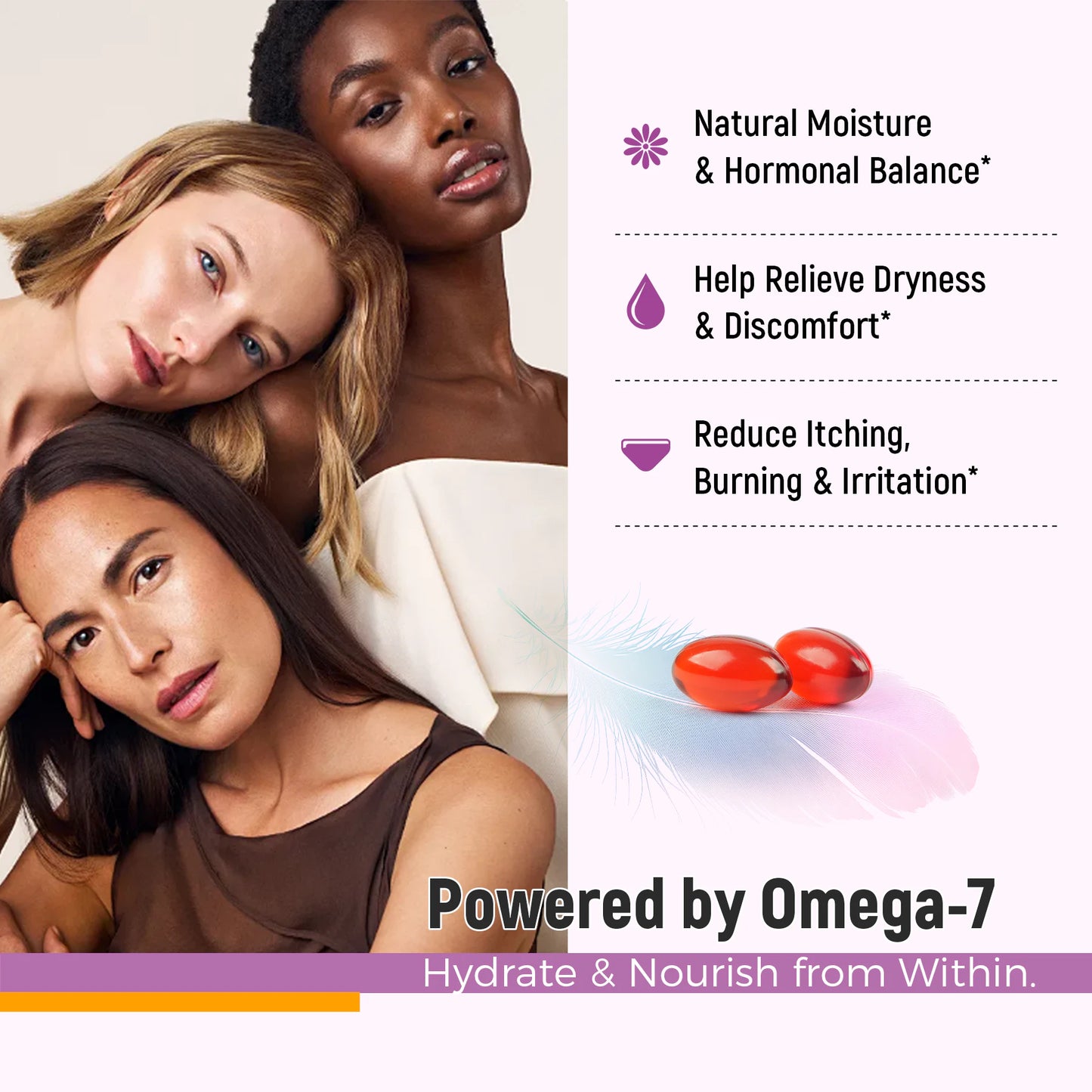
Laicuherb Feminine Moisture Support is described as a vegan oral softgel containing 1,000 mg of organic whole sea-buckthorn oil per serving and 324 mg of Omega-7, with Omega-3, Omega-6, Omega-9, vitamin E, vitamin A, plant sterols, and natural carotenoids listed in the supplied product information. The product is also described as non-hormonal and free from gluten, soy, dairy, artificial colors, and preservatives. Confirm the current package and product page before publishing or relying on any specification.
The product information states that the whole sea-buckthorn berry oil is obtained using CO2 extraction. That tells the reader about the production method. It does not establish that the finished softgel treats dryness, restores tissue, or changes hormone-related symptoms.
A randomized, placebo-controlled study of sea-buckthorn oil intake in postmenopausal women reported findings related to vaginal atrophy [3]. A study of one preparation, dose, population, and duration cannot automatically validate every sea-buckthorn product or prove that a specific softgel will produce the same result. Ingredient research is a reason to investigate—not a permission slip for a product guarantee.
For that reason, this article describes Feminine Moisture Support as a non-hormonal oral wellness supplement that may be considered as part of a broader conversation about personal comfort. It is not presented as a medical therapy, a substitute for local care, or a replacement for prescribed treatment.
Comparison Table: Key Differences at a Glance
| Dimension | Topical Moisturizer | Oral Supplement |
|---|---|---|
| Application | Applied locally to the vaginal area | Swallowed as a daily softgel |
| Primary role | Immediate local moisture & comfort support | Systemic delivery of botanical nutrients and Omegas |
| Evidence base | Graded recommendations in global guidelines [1][2] | Formulation-specific studies; results cannot be generalized [3] |
| Hormone content | Varies (non-hormonal over-the-counter vs. prescription) | Laicuherb formula is non-hormonal |
| Key risk factors | Local tissue sensitivity, irritation or pH imbalance | Medication interactions, allergies, and supplement quality |
Why Neither Option Is a Universal Replacement
Intimate dryness can have more than one cause. Perimenopausal estrogen changes, breastfeeding and postpartum recovery, medications, stress, health conditions, irritation, and infections can all enter the conversation. A supplement cannot be chosen intelligently without considering the reason for the symptom.
Topical moisturizers may be useful for local comfort, but they do not diagnose the cause. An oral sea-buckthorn supplement may suit someone who prefers a daily softgel, but it cannot replace a topical product when local application is what provides relief. Neither is a universal substitute for prescribed hormonal or non-hormonal treatment when a clinician recommends it.
Guidelines are also more nuanced than a simple product ranking. The 2025 AUA/SUFU/AUGS guideline discusses several treatment options for genitourinary syndrome of menopause and grades them according to evidence and recommendation strength [1]. The right choice depends on symptoms, health history, contraindications, preferences, and whether the person needs evaluation rather than another product.
A sensible comfort plan may include a local moisturizer, a lubricant for sexual activity, an oral supplement, prescription care, or none of these. The point is not to combine everything. The point is to choose based on the problem being addressed.
How to Choose Based on Symptoms and Professional Advice
Start with the symptom and the time frame. If you want short-term friction reduction during sexual activity, a lubricant is the relevant category. If you want a product used regularly for local dryness, a vaginal moisturizer may be the more direct option. If you prefer a daily oral wellness routine and want to discuss sea-buckthorn oil with a professional, an oral supplement may be a format to consider—but it is not a local treatment.
Lifestyle also matters. Some people prefer the privacy and simplicity of a softgel. Others prefer an application that acts directly where the discomfort occurs. Neither preference proves efficacy. It simply helps determine what is practical enough to use consistently.
If you are pregnant, breastfeeding, taking medication, recovering after a procedure, or managing a medical condition, ask a healthcare professional before starting a supplement. Bring the current ingredient list rather than relying on a general description of “natural” support. For questions about Laicuherb Feminine Moisture Support and its available product documentation, contact hello@laicuherb.com.
The useful decision is not “oral or topical forever.” It is “what problem am I trying to address, what evidence applies to this product, and when do I need an examination?”
When Intimate Dryness Needs Medical Evaluation
Persistent dryness deserves attention when it keeps returning, interferes with daily life or sexual activity, or does not improve with an appropriate moisturizer or lubricant. Seek medical advice for bleeding, unusual discharge or odor, sores, significant pain, burning, recurrent urinary symptoms, pain with urination, or symptoms that began after a medication or procedure.
Mayo Clinic notes that vaginal dryness can be associated with hormonal changes, medications, breastfeeding, and other health factors [2]. The symptom alone cannot identify the cause. A clinician may need to ask about menstruation, menopause status, childbirth, breastfeeding, medications, sexual pain, urinary symptoms, infection risk, and skin changes.
Sea-buckthorn oil and other feminine moisture supplements are not diagnostic tools. They should not be used to postpone an examination. If symptoms are persistent or concerning, professional evaluation comes before experimenting with a new supplement.
Product Spotlight: Laicuherb Feminine Moisture Support

Frequently Asked Questions
How do lubricants, moisturizers, and an oral feminine moisture supplement differ?
Lubricants are generally used during sexual activity to reduce friction. Vaginal moisturizers are used regularly for local dryness and comfort. An oral feminine moisture supplement, such as Laicuherb’s sea-buckthorn oil softgel, is swallowed and delivers its ingredients through digestion. It is not a topical moisturizer and should not be expected to provide the same immediate local effect.
Does the Laicuherb feminine moisture supplement contain hormones?
The supplied product information describes Laicuherb Feminine Moisture Support as non-hormonal. That means the formula is not presented as containing hormones. It does not mean the supplement balances hormone levels, reverses estrogen-related changes, or replaces prescribed hormonal therapy. Check the current product label for the most up-to-date formula and ingredient information.
Can oral use of a supplement replace topical moisturizers or hormonal therapy?
No. An oral supplement should not be treated as a substitute for a topical moisturizer, lubricant, or prescription treatment when one is appropriate. The evidence for oral supplements is formulation-specific, and a sea-buckthorn study cannot be transferred automatically to every product [1][3]. Persistent or painful symptoms require professional evaluation rather than a choice between marketing claims.
Global Sourcing & Safety Standards
HALAL • HACCP • ISO-FSSC • SGS Analyzed • USDA Organic Sourcing
References
- American Urological Association, Society of Urodynamics, Female Pelvic Medicine & Urogenital Reconstruction, and American Urogynecologic Society. (2025). "Evaluation and Management of Genitourinary Syndrome of Menopause: AUA/SUFU/AUGS Guideline." The Journal of Urology, 213(4), 622–635.
- Thielen, J. M. (2024). "Vaginal moisturizers and lubricants: What’s the difference?" Mayo Clinic Press.
- Larmo, P. S., et al. (2014). "Effects of sea buckthorn oil intake on vaginal atrophy in postmenopausal women: A randomized, double-blind, placebo-controlled study." European Journal of Clinical Nutrition, 68(12), 1340–1346. (PMID: 25104604)
- The North American Menopause Society. (2022). "NAMS position statement on nonhormonal management of menopause-associated vasomotor symptoms and genitourinary syndrome of menopause." Menopause, 29(11), 1284–1300.
- Stuenkel, C. A., et al. (2023). "Management of genitourinary syndrome of menopause in clinical practice." JAMA Internal Medicine, 183(5), 394–405.
- Kallio, H., et al. (2014). "Triacylglycerols, glycerophospholipids, and sphingolipids of sea buckthorn berries and seeds." European Journal of Lipid Science and Technology, 116(6), 724–733.