Skin Glow Supplement with Collagen: Can You Take Both?
HiherbsOfficial
One tub of collagen powder. One bottle of Skin Glow. Both are sold as skin-support products. The practical question is narrower: can they sit in the same day, and what should you check before they do?
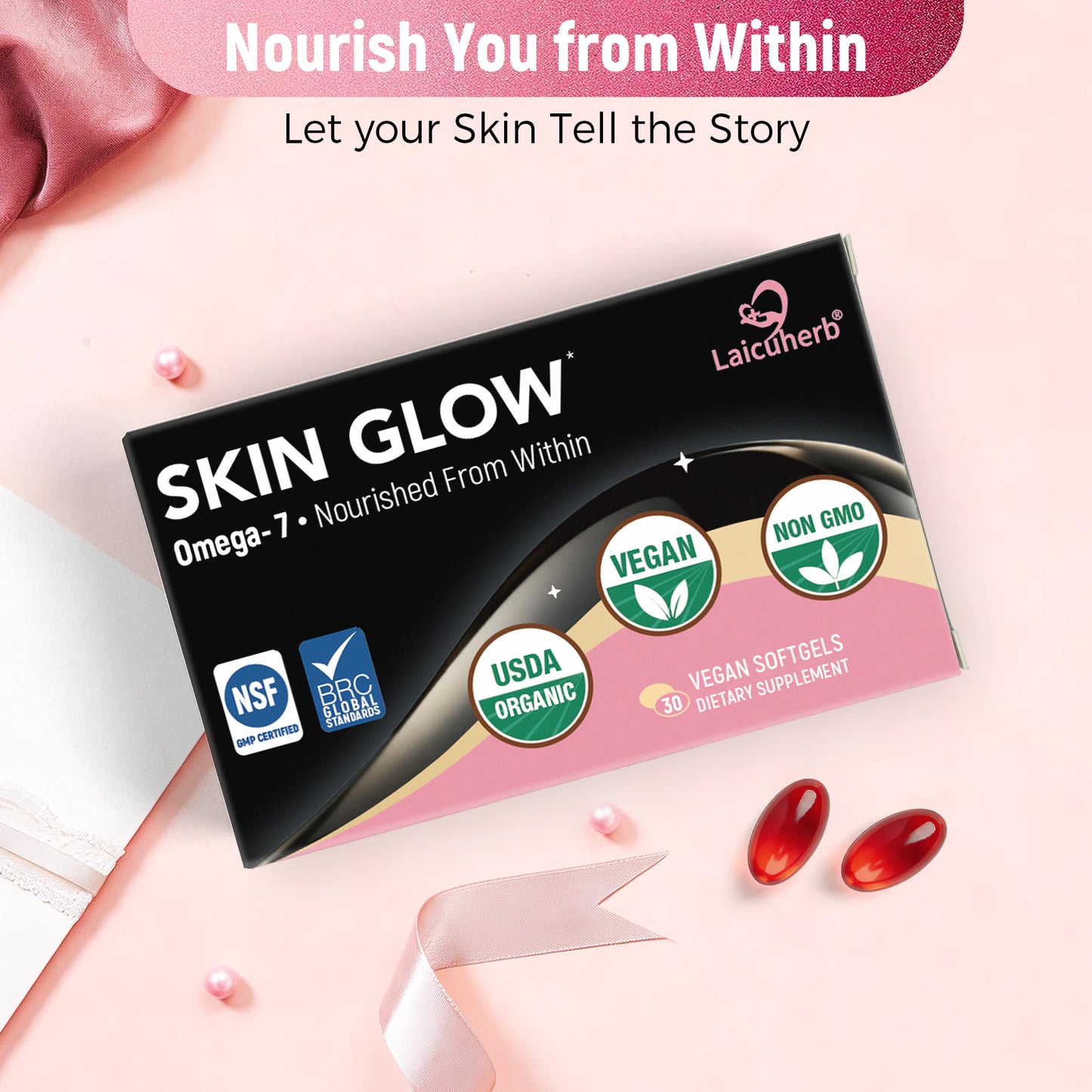
Hydrolyzed collagen is broken-down protein. Laicuherb Skin Glow Supplement is USDA Organic whole sea buckthorn berry oil in a vegan softgel, with omega-3, omega-6, omega-7, and omega-9 listed on the Supplement Facts panel. They are not the same category. There is also no published trial of this pair used together.
The useful order is not “stack them and wait for glow.” It is: both labels, then medicines and conditions, then one product at a time.
Contents
Quick Answer: Many People Use Both Categories — That Is Not a Studied Stack
Hydrolyzed collagen is short amino-acid chains, usually from bovine, porcine, or marine sources. Skin Glow is a lipid product: Organic Sea Buckthorn Oil, 1000 mg per serving (2 vegan softgels), 15 servings per bottle [6]. The panel lists omega-7 (palmitoleic acid) 324 mg, omega-9 245 mg, omega-6 103 mg, and omega-3 (ALA) 22 mg, plus vitamin E, vitamin A as beta-carotene, plant sterols, and natural carotenoids [6].
Those two routes are not automatically redundant. They are also not automatically a pair you should open on the same morning. “Plenty of people use both categories” is not the same as “this combination is studied” or “this combination is right for you.”
Read both Supplement Facts panels for overlapping extras — vitamin C, biotin, zinc, hyaluronic acid — and for allergens. If you take prescription medicine, are pregnant or breastfeeding, have a procedure scheduled, or have a fish or shellfish allergy, ask a pharmacist or clinician before you add the second bottle. If you do use both, add one first so you can see what each one does.
How the Two Product Categories Differ
Collagen powders supply glycine, proline, and hydroxyproline after hydrolysis. Oral collagen research exists — but it is not research on sea buckthorn, and it is not research on every powder on the market. Proksch et al. (2014) tested a specific bioactive collagen peptide, not a generic kitchen-counter tub [1]. Choi et al. (2019) reviewed oral collagen for dermatological uses and called the findings preliminary [2].
Skin Glow is not collagen. The product page states that directly [6]. It is whole sea buckthorn oil, plant-based, vegan, USDA Organic, gluten-free, and non-GMO, made in an NSF cGMP facility with BRCGS listed among quality documents [6]. Yang and Kallio (2001) and Zielińska and Nowak (2017) describe how sea buckthorn berry lipids vary by origin and what fatty acids the oil can contain [3][4]. That is composition context. It is not a head-to-head trial against collagen, and it is not a guarantee of a cosmetic result.
Different categories can sit in the same routine. Difference is not proof they should.
Checking Labels for Duplicate Nutrients and Allergens

Put both containers on the table. Skip the front of the tub. Read the Supplement Facts line by line.
Collagen formulas often add vitamin C, biotin, hyaluronic acid, or zinc. If the powder already has 500 mg of vitamin C and a multivitamin has another 500 mg, that total exists before Skin Glow is opened. Skin Glow's other ingredients are the vegan softgel shell: tapioca starch, vegetable glycerin, and purified water. It is listed as free from gluten, soy, dairy, and artificial colors, flavors, sweeteners, and preservatives [6]. Still read the collagen label for fish, shellfish, or bovine source if those matter to you.
Marine collagen is a seafood-allergy question. Sea buckthorn oil is plant-based. Neither fact replaces a clinician if you have a known allergy. If the two panels look compatible, the next check is medicines and health conditions. Product composition or sourcing questions: hiherbs0129@gmail.com.
Medication and Health-Condition Review
Supplement safety sits on top of everything else you already take.
Bays (2007) reviewed safety issues with omega-3 fatty acid therapy, including a theoretical bleeding concern with antithrombotic drugs [5]. That literature is largely about concentrated EPA/DHA regimens, not about 22 mg of ALA in one Skin Glow serving [5][6]. Do not treat that paper as proof that this softgel thins blood. Do treat warfarin, other anticoagulants, antiplatelet drugs, and upcoming surgery as a reason to ask the clinician who manages those medicines before you add any new oil supplement.
Collagen is food-derived protein for most healthy adults. Fish- or shellfish-sourced collagen is still an allergen problem if you react to those foods. Data on collagen plus sea buckthorn oil plus specific drugs, used together, is not well established. That is why the question belongs with a pharmacist or physician, not with a blog. None of this means the two products cannot be used by the same person. It means the combo is not pre-cleared for every health file.
Does Timing Matter? Evidence Versus Routine
Empty-stomach collagen and with-food oil are common internet rules. The physiology is simple enough: fat-soluble compounds are often absorbed better with dietary fat. Proksch et al. (2014) did not establish a required clock time for collagen [1]. There is no published best hour for taking collagen powder and Skin Glow in the same day.
A workable routine is enough: collagen when you already remember a drink, Skin Glow with a meal that contains some fat, matching the label. Consistency is the part you can control. A perfect timing protocol is not in the evidence.
How to Introduce One Product at a Time
If both bottles start on Monday and skin looks different in week six, you cannot tell which product moved — or which one disagreed with you.
Pick one. Keep the rest of the routine still for two to four weeks: same cleanser, same moisturizer, same sleep window if you can. Then add the second. That gap is not a medical protocol. It is the only way a household test answers “which bottle?”
How to Track Changes Without False Attribution
Memory is bad at slow skin changes. A new moisturizer, more water, a week of better sleep, or seasonal humidity can sit in the same month as a new supplement.
One bare-faced photo a week, same window, same time of day. A few words on dryness, tightness, redness, and comfort. Note the start date of each bottle. At 8–12 weeks, compare the photos to the notes. That file tells you whether both products are earning their place, or whether one is doing the work you care about.
Conclusion
What this pairing can and cannot claim
- Collagen powder and Laicuherb Skin Glow Supplement are different categories: hydrolyzed peptides versus USDA Organic whole sea buckthorn oil.
- They are not proven partners and they are not proven duplicates.
- Check labels for extra nutrients and allergens. Check medicines and conditions with a clinician when those apply. Add one product at a time. Photos and dates beat guesswork.
A dietary supplement is not a diagnosis, and a kitchen-counter stack is not a clinical protocol.
FAQ
Hiherbs
Laicuherb Skin Glow Supplement
USDA Organic whole sea buckthorn berry oil · vegan softgel · 2 softgels / 1000 mg oil per serving · 15 servings per bottle · omega-3, 6, 7, 9 · not a collagen product and not required as a partner to collagen · quality documents listed include BRCGS, NSF cGMP, gluten-free, and non-GMO [6]
View Product Page →Ingredient, sourcing, and certificate questions: hiherbs0129@gmail.com. This product is a dietary supplement. It is not intended to diagnose, treat, cure, or prevent disease. If dryness, redness, or other skin changes are persistent or concerning, talk with a qualified clinician.
References
- Proksch, E., Schunck, M., Zague, V., Segger, D., Degwert, J., & Oesser, S. (2014). Oral intake of specific bioactive collagen peptides reduces skin wrinkles and increases dermal matrix synthesis. Skin Pharmacology and Physiology, 27(3), 113–119. https://pubmed.ncbi.nlm.nih.gov/24401291/
- Choi, F. D., Sung, C. T., Juhasz, M. L., & Mesinkovska, N. A. (2019). Oral collagen supplementation: A systematic review of dermatological applications. Journal of Drugs in Dermatology, 18(1), 9–16. https://pubmed.ncbi.nlm.nih.gov/30681787/
- Yang, B., & Kallio, H. P. (2001). Fatty acid composition of lipids in sea buckthorn (Hippophaë rhamnoides L.) berries of different origins. Journal of Agricultural and Food Chemistry, 49(4), 1939–1947. https://pubmed.ncbi.nlm.nih.gov/11308350/
- Zielińska, A., & Nowak, I. (2017). Abundance of active ingredients in sea-buckthorn oil. Lipids in Health and Disease, 16, 95. https://pubmed.ncbi.nlm.nih.gov/28526097/
- Bays, H. E. (2007). Safety considerations with omega-3 fatty acid therapy. American Journal of Cardiology, 99(6A), 35C–43C. https://pubmed.ncbi.nlm.nih.gov/17368277/
- Laicuherb. Skin Glow Supplement. Product facts as supplied on the current product page [6].
Original article source reference: Laicuherb Editorial. Skin Glow Supplement with Collagen: Can You Take Both? Laicuherb.com.