Sea Buckthorn: Botanical Origins and Why Himalayan Matters
HiherbsOfficial
“Himalayan” on a sea buckthorn label is a place claim. It is useful when it points to a real growing region. It is not a lab number by itself.
Sea buckthorn (Hippophae rhamnoides) grows across a wide band of Eurasia. Oils from different subspecies and sites do not share one fatty-acid fingerprint [1]. Altitude, climate, and which part of the berry is pressed all show up in composition studies [1][3]. Extraction method is a second filter: heat and solvents are not the same process as low-temperature CO2 [5].
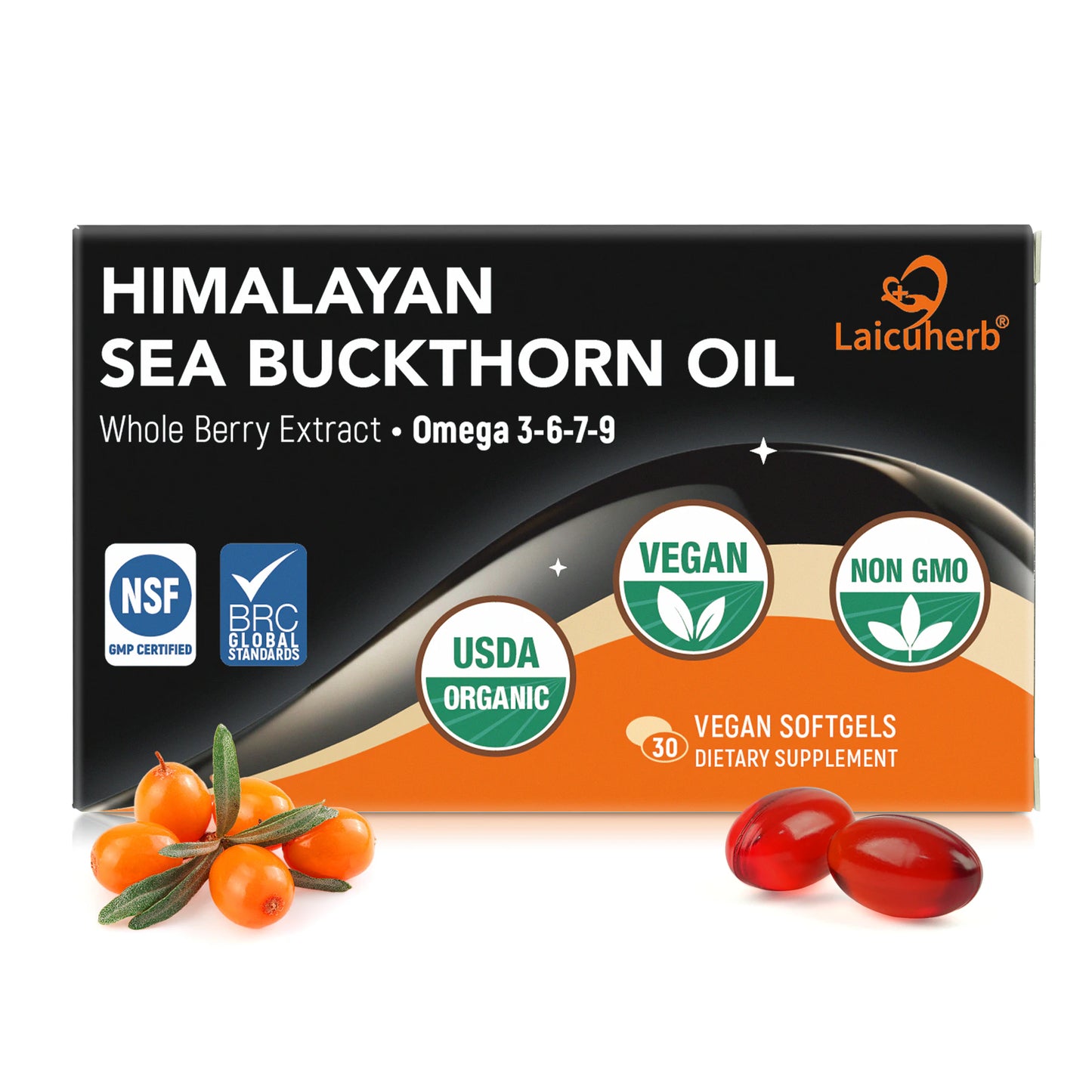
Laicuherb Himalayan Sea Buckthorn Oil is labeled USDA Organic whole-berry oil in vegan softgels: 2 capsules, 1000 mg oil, 15 servings per bottle, supercritical CO2, NSF cGMP and BRC facilities [6]. This article is about how to read origin and process. It is not a treatment guide.
Contents
Quick Answer: High-Altitude Growth Increases Omega and Carotenoid Density
The honest version of that headline is narrower. Reviews of sea buckthorn chemistry describe vitamin C, carotenoids, flavonoids, and unusual pulp lipids — including palmitoleic acid (omega-7) — and they note that growing conditions (climate, latitude, altitude) can shift those levels [3]. Yang and Kallio compared berries of different origins and found measurable fatty-acid differences between subspecies and sites, not a single “highland always denser” score [1].
What origin can signal
Habitat: high-mountain ecology, subspecies, harvest year, and which tissue was pressed. Those are reasons two oils can look different on a fatty-acid panel.
What it cannot print
A guaranteed milligram premium versus every lowland oil. Batch, season, subspecies, and the lab method still move the numbers. Read the Supplement Facts on this bottle [6].
So “Himalayan” is a quality signal about habitat, not a coupon for higher omega-7 in every lot.
Sea Buckthorn: Botanical Profile and Global Distribution
Botanical Profile and Habitat
Hippophae rhamnoides is a thorny shrub in the oleaster family (Elaeagnaceae). It is nitrogen-fixing and colonizes poor, sandy, or rocky ground. The orange berries are the usual oil source; seed and pulp lipids are chemically different [1][3]. Traditional use of leaf and bark exists in some regions; this product is whole-berry oil in a softgel, not a leaf tea [6].
The species is native across a broad Eurasian range — from parts of Europe through Central Asia into China and the Himalayan highlands — not a plant that exists only on one ridge [2][3].
Himalayan Origin and High-Altitude Characteristics
Himalayan populations are often described in the high-mountain belt of the western and central Himalaya (including areas of India, Nepal, and the Tibetan plateau). Brand copy for this oil states wild harvest at extreme Himalayan altitude, including a figure of over 12,000 feet on the product FAQ [6]. Treat that as the sourcing claim to verify (traceability, COA, harvest region) — not as a clinical potency ranking.
“Himalayan sea buckthorn plant origin” here means: this SKU is positioned as high-altitude Himalayan fruit, whole berry, CO2-extracted [6]. It does not mean other origins are fake sea buckthorn.
How Altitude and UV Exposure Affect Berry Composition
High sites bring stronger UV, larger day–night temperature swings, and often lean soils. Plant reviews treat those stresses as one reason secondary metabolites (phenolics, carotenoids, some vitamins) vary with environment [3]. That is ecology, not a coupon for higher omega-7 in every Himalayan lot.
Fatty acids in sea buckthorn are also partitioned by tissue: pulp lipids are rich in palmitic and palmitoleic acids; seed lipids are richer in linoleic and α-linolenic acids [1]. Origin studies mix subspecies (rhamnoides, mongolica, and others) with geography. You cannot collapse that into “altitude = more of everything.”
Responsible reading: origin explains why two oils can look different on a fatty-acid panel. The panel — or this label’s 324 mg omega-7, 245 mg omega-9, 103 mg omega-6, 22 mg ALA per serving — is what you can check [6].
Whole Berry vs Seed vs Pulp: Different Fatty Acid Profiles
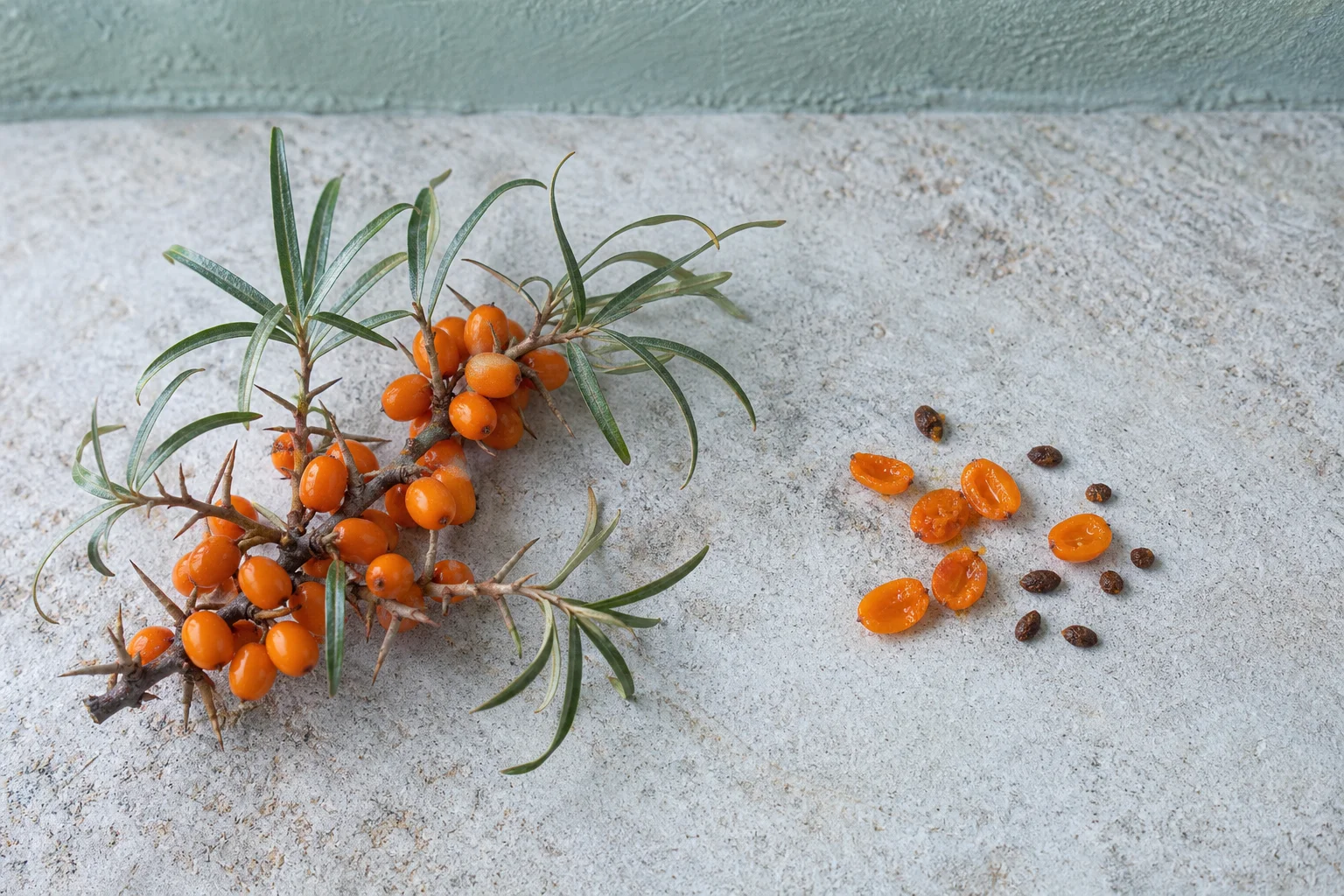
Thorny branch, pulp, and seeds for tissue context. AI-generated scene, not product packaging.
Seed oil and pulp oil are not interchangeable [1].
Seed-forward
Leans omega-6 and omega-3 (linoleic, ALA). A seed-only oil is a real sea buckthorn product with a different job. Neither is “wrong.”
Pulp-forward
Leans palmitoleic acid (omega-7) plus palmitic. A pulp-only oil is the same plant with a different fingerprint.
Laicuherb’s oil is whole berry: seed plus pulp, labeled to keep omega-3, -6, -7, and -9 on one facts panel [6]. That is a formulation choice so one serving includes both fingerprints. It is not proof of a health outcome. Questions on the panel: hiherbs0129@gmail.com. Compare with a clinician or pharmacist if you already take other oils.
Why CO2 Extraction Preserves More Bioactive Compounds
Supercritical CO2 extraction is used on botanicals because CO2 can be tuned as a solvent and then vented, leaving no hexane residue, often at milder temperatures than some classical solvent routes [5]. Heat-sensitive pigments and volatiles are the usual reason engineers pick it.
That is process chemistry. It does not mean every CO2 oil is nutritionally superior to every cold-pressed or solvent oil, and it does not mean this softgel “captures every drop of nutrition.” It means this SKU is made without named organic solvents, at low temperature, according to the brand [6].
Pair origin with process: Himalayan whole fruit + CO2 is a traceable story. Verify with batch testing (fatty acids, oxidation, contaminants) if that matters to you.
Conclusion
Sea buckthorn chemistry has two fingerprints you can actually discuss: where and what was grown, and which part of the berry was extracted. Himalayan origin points to a high-altitude ecology that can shift phytochemicals; it does not print a density guarantee on the bottle [1][3]. Whole-berry extraction puts seed and pulp lipids in one serving [1][6]. CO2 extraction is a clean, lower-heat method in the engineering literature [5]. Laicuherb Himalayan Sea Buckthorn Oil: USDA Organic, vegan, 15 servings, 1000 mg oil, full listed omega split, NSF cGMP / BRC [6]. Origin and process are quality signals. They are not medicines.
FAQ
Hiherbs
Laicuherb Himalayan Sea Buckthorn Oil
If you want a plant omega oil with a Himalayan whole-berry, CO2, USDA Organic story, that is this SKU: 2 vegan softgels, 15 servings, 1000 mg oil [6]. Read origin as habitat plus process, then read the milligrams on the bottle.
View Himalayan Sea Buckthorn Oil →Product questions: hiherbs0129@gmail.com
References
- Yang, B., & Kallio, H. P. (2001). Fatty acid composition of lipids in sea buckthorn (Hippophaë rhamnoides L.) berries of different origins. Journal of Agricultural and Food Chemistry, 49(4), 1939–1947. https://pubmed.ncbi.nlm.nih.gov/11308350/
- Suryakumar, G., & Gupta, A. (2011). Medicinal and therapeutic potential of sea buckthorn (Hippophae rhamnoides L.). Journal of Ethnopharmacology, 138(2), 268–278. https://pubmed.ncbi.nlm.nih.gov/21963559/
- Bal, L. M., Meda, V., Naik, S. N., & Satya, S. (2011). Sea buckthorn berries: A potential source of valuable nutrients for nutraceuticals and cosmeceuticals. Food Research International, 44(7), 1718–1727. https://doi.org/10.1016/j.foodres.2011.03.002
- Zeb, A. (2004). Chemical and nutritional constituents of sea buckthorn juice. Pakistan Journal of Nutrition, 3(2), 99–106.
- Reverchon, E., & De Marco, I. (2006). Supercritical fluid extraction and fractionation of natural matter. The Journal of Supercritical Fluids, 38(2), 146–166. https://doi.org/10.1016/j.supflu.2006.03.020
- Laicuherb. Himalayan Sea Buckthorn Oil. Product facts as supplied: USDA Organic whole-berry oil in vegan softgels; 2 capsules, 1000 mg oil, 15 servings per bottle; supercritical CO2; NSF cGMP and BRC facilities; labeled omega split 324 mg omega-7, 245 mg omega-9, 103 mg omega-6, 22 mg ALA per serving; product FAQ states wild harvest at extreme Himalayan altitude, including a figure of over 12,000 feet, treated here as a sourcing claim to verify. Oral vegan softgel; not for skin application or cooking. https://www.laicuherb.com/cardiovascular/himalayan-sea-buckthorn-oil
Original article source reference: Laicuherb Editorial. Sea Buckthorn: A Guide to Its Botanical Origins and Why “Himalayan” Matters. Laicuherb.com.